Posted by:


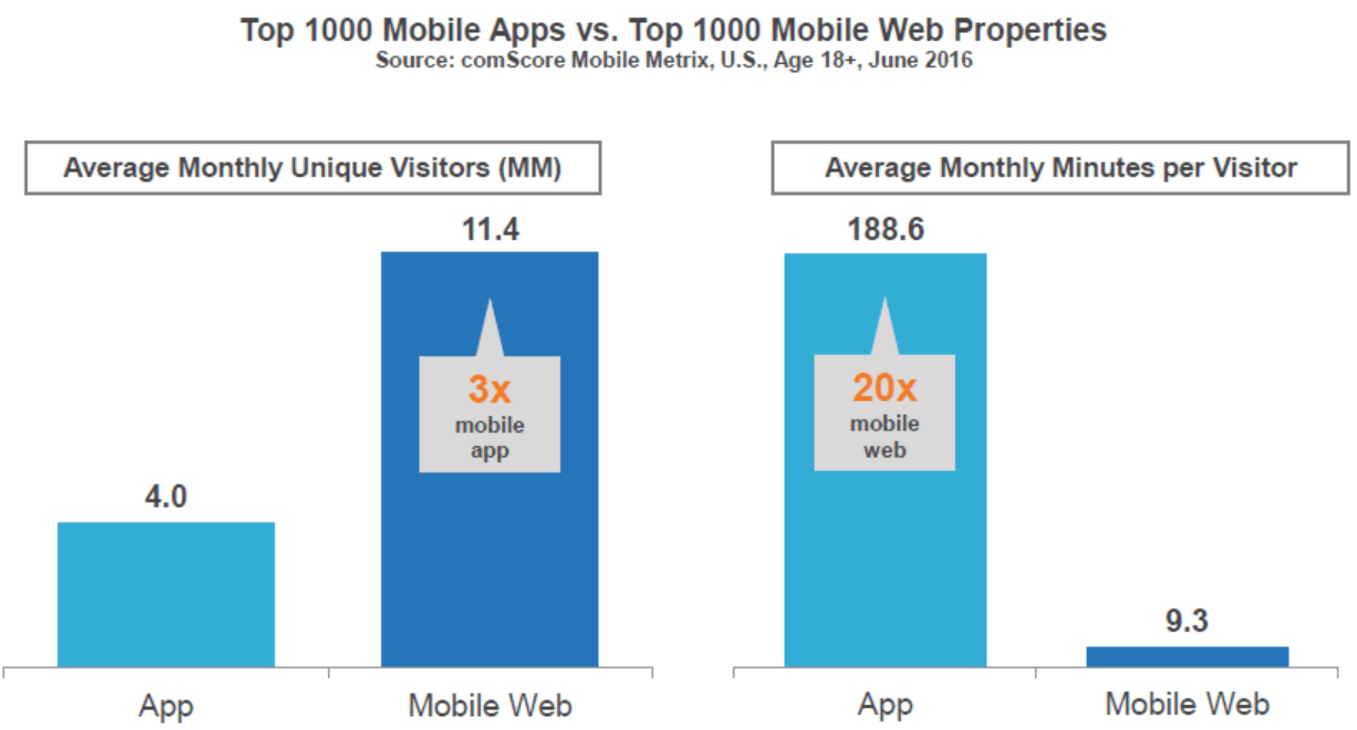
It has got to a time where there is such a reliance on our mobile phones, tablets and other technologies that mobile apps are quickly becoming something that we use every day and soon they will be something that we will not be able to live without. In fact a Smarts Insights report shows that the consumer preference for mobile media time is with mobile apps – with 89% of media time in mobile being used on them, compared to 11% being spent on media through the mobile web. Because of this, there is now a mobile app for almost anything these days, but the question is which are the most useful? Fortunately for you, we’ve put together a list of the top 5 most useful.

Waze

We’ve all had trouble with Google Maps at some point or another, and that’s where Waze comes in. Waze took the GPS navigation world by storm in 2014, as its interactive app allowed users to find the most accurate traffic reports with the latest accidents, police traps, road debris and any delays all reported immediately, by the users themselves as soon as you see them. Simply, Waze gets you from point A to point B in the quickest time possible, whereas we all know how Google Maps likes to take us around the houses. It can also help to make your daily commute a little more fun as the more accidents that you report, the more points you earn so you can level up. The app is compatible with iPhone, Android and Windows Phone and the best part is that it’s free. Waze has also had some excellent reviews showing just how popular it really is.

AroundMe

If you’re travelling around a lot for work, or you’re simply going on a few trips soon, then you might want to download AroundMe. AroundMe is an app that will simply let you know what is around you. Whether you’re looking for a new restaurant to try, a gas station or simply a place to park, AroundMe can help. It even has a GroupOn deals section so you can find the deals that are in your area saving you money. AroundMe can also show you the nearest activities such as beaches and casinos, so if you’ve studied some casino games with online information guides such as the Ladbrokes Basic Blackjack Guide and you’re looking for the nearest casino to try your new skills in, just log onto AroundMe. If you’re not sure where you are, then download AroundMe. Available on both iPhone and Android and available for free.

2016-10-10-useful-apps There is a mobile app for anything these days, but what are the top 5 most useful?

Cloze

Cloze is a genius idea that works a little bit like Hootsuite in the fact that you can have all of your social media accounts all in one place. This way, you don’t have to check four different websites or apps to see what you want to see as with Cloze, everything is all in one place. It can also organise your contacts into who you last spoke to so everyone that you speak to is just a single click away. The app is available on both Android and iPhone, and on the plus side it is free.

Uber/Lyft

If you’ve never experience Uber or Lyft before, then you’re seriously missing out. Uber is essentially a taxi service where you can be picked up by a driver that is in your area, and while the fare is metered like a normal taxi cab, the price tends to be significantly cheaper and no money actually changes hands – it all comes straight from the bank card that is connected to your account. You’ll find that your waiting times are cut in half and that your journey cost is also significantly reduced with Uber. Lyft on the other hand is a ride-sharing service which works in a similar way to Uber in the fact that it’s a cashless system. With Lyft, all of the cars also tote giant pink moustaches to really give you that element of fun so you never feel awkward in a taxi again.

30/30

If your day needs a little more organisation, then turn to 30/30. Essential this is a to-do list, but in many respects it is so much more than a to-do list. It’s simple and colourful, and you can give yourself time limits on the tasks that you want to do, so your day is planned out from start to finish. This is perfect for work purposes and also for day to day life. The app will alert you when it’s time to move on to your next time, making sure that your day is organised to the max. It’s compatible on iPhone and Android and one of the bonuses is that it is free.

Posted by:


“Whoever comes into the marketplace is going to have to work through us” – those were the strong words of then CEO of Vodafone, Arun Sarin in 2007. Arguable he missed that one by a few football fields. Whether greed, arrogance or technical ineptness served to marginalize mobile operator as the universal payment and billing gateway is up for debate.  But there are places where they do still matter.

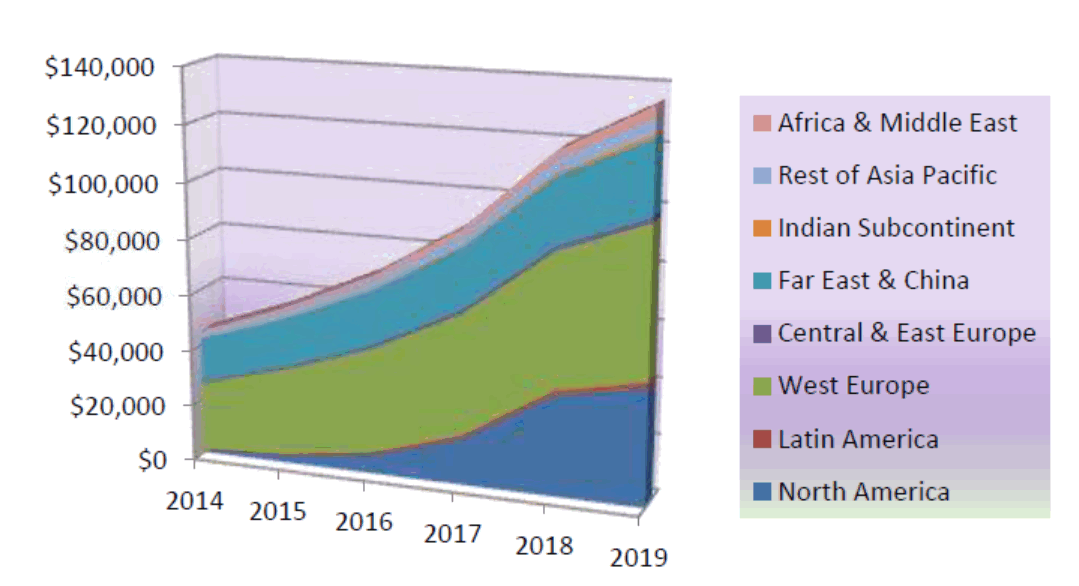
Vision Mobile in their report “The Evolving State of Mobile Commerce” points to that mobile operators indeed matter in the Middle East and Africa, but that they have been marginalized pretty much everywhere:

2016-10-02-Billing-map The curious case of mobile operator billing

Of course, this considers all mobile commerce transactions. One can argue that for micro-billing (i.e. app purchases etc), they still do matter, as fixed costs from card networks and banks often can then be compared to the high % fees charged by operators due to the lower Average Order Values (AOVs).

Needless to say, companies who are entrenched in the mobile operator billing business may not be the most objective source of information on the state of the industry, but industry leader Fortumo does point to quite healthy growth rates, with way over 100% growth rates in massive markets like Indonesia.

What is the main reason behind this growth, besides increasing smartphone penetration? Well, few will argue that the one-click experience mobile billing offers is the key characteristic behind it’s attractiveness. But few will also dispute that greedy carriers who often keep 50% or more (still much the case in markets like Brazil and India), is some of the top reasons the industry shies away from using mobile operator billing. But even in markets like Indonesia, where payouts are in the 30% mark, we can see triple digit growth, which is impressive.

Carrier billing has puzzled us for years, and no doubt will for many more to come…

Posted by:


There is lots of excitement about the revenue generated from Pokemon Go.  Sure, $1,6m per day or $200m in revenue in a month is nothing to shrug away, not is an expected $36,9bn in total mobile games revenue expected for 2016. But that is peanuts compared to expected growth in mobile gambling revenues.

How big is mobile gambling?

So how big is gambling on mobile? Figures vary. Interactive gambling is approximately a €35bn business according to iGamingbusiness. Out of that, approximately 30% or more is expected to be from mobile, so it would put it at app €10bn. However, Juniper predicted that over $60bn was wagered this year:

2016-08-15-Total-wager-mobile-gambling-Juniper Alternative App stores and gambling - match made in heaven?

(Source: Juniper)

The growth is expected to be staggering, largely attributable to changes in US regulation coming into play, as the US moves from fantasy sports to traditional gambling. The US market alone is expected to grow from $6bn wagered this year to $135bn wagered in 3 years.

Where can you find the apps?

So where can you find apps that involve gambling? Well Google is taking it slow, most likely due to the roll-out of US legislation on this. Alternative App Stores may be the way to go for anyone interested in these types of apps. Providers of betting related games, like online casino and the likes also allow direct downloads from their sites.  This market will no doubt be a very interesting one to follow in the next couple of years.

Posted by:


Short message service (SMS) marketing is a tool that any industry can take advantage of. Whether it’s for internal use or promoting sales, text messaging has something to offer all businesses. It is a feature that almost everyone is comfortable with giving it a great advantage over other mediums such as email and social media.

Check out these four stats on SMS marketing:

● 75 percent of people would prefer to have offers sent to them
● The average millennial sends out 67 texts per day
● 80 percent of people use some form of texting for their business
● 23 BILLION text messages are sent per day

For more details on SMS marketing, take a look at the beginner’s guide below created by Trumpia.

a071856f-8b91-4131-a7cb-49cc088acfea-1 The beauty of SMS in marketing

Posted by:


Pokemon Go has injected a much needed excitement into the mobile games market. An excitement not experienced since we all flipped birds on pigs. And while Pokemon Go started as a franchised set of characters, and Angry Birds went the other way – what constitutes them both is that they are originally genuinely fresh. The creators are heralded as geniuses, no doubt inspiring new game creators all over the world. But how normal is the phenomenon of original content mega hits in the creative world?

Quick trivia question: How many titles did Rovio have before Angry Birds? The answer is approximately 50. How many titles does Rovio have that have gone to top of the charts that is not a variation of Angry Birds? Zero. So while the geniuses came up with the idea, they have not come up with any new ideas. And the glut does not stop in Finland.

A look at Hollywood

Surely there can be examples of creative people that keep creating good stuff? Well, George Lucas created something amazingly exciting in Star Wars – a New Hope in the late 70s, but all the following milked the original (or rather were part of the same story told over several movies). You could argue Indiana Jones was pretty cool too, but never achieved the height of Star Wars. But surely Hollywood keeps on throwing out new original amazing stuff? Not exactly. Out of 2014 box office hits for instance, none were original. Spinoffs, sequels, making movies out of books — you’d have to turn a lot of stones in Los Angeles to find any script that smelled of original content that made it big.

2016-07-the-truth-app A few good men (and women)

How about musicians?

Well ok, so the movie industry may be subject to milking existing concepts over and over again. But music, surely that is a different story? Well, you will be surprised to find out that the majority of hits on the charts are written by a few bald Norwegians. Sounds crazy right? Taylor Swift, Fifth Harmony, The Weeknd, Minaj, David Guetta, Britney Spears, Nsync, Pink, Kelly Clarkson, Maroon 5, Katy Perry and more — all get a substantial portion of their material from a few individuals.

At least the “music makers” keep producing hits. That is more to be said about games makers, film makers and the like. Authors may be best placed as J.K. Rowling seems to make no mistakes, and Tolkien is a legend. Jo Nesbo keeps coming with the hits, and so does others. So writing seems to be the one creative art form where creativity lives and can be replicated – and where the power of creativity is spread out among many. Not the case for gaming.

Hang in there

The beauty of it though – it can still be done. As more and more mobile developers join the party, we hope soon that means more creativity, more original content, and more Pokemon Go like hits. Keep at it!

p.s. To note, our title “A Few Good Men”, was indeed an original screenplay by Aaron Sorkin. Again, writers rule…

Posted by:


Facebook is the undisputed king of mobile app advertising. For the price of $3.40 per install on average, $2.9 billion is spent of marketing apps on Facebook. Few can argue the platforms strong ability to target users. But the price is steep. Does it pay off?

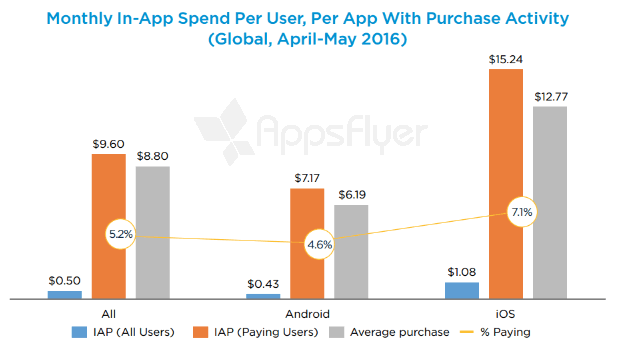
It starts with your business model. Appsflyer claims that in-app-purchase (IAP) models are by far more lucrative than advertising financed apps. Regardless of the category of your app, you can expect that a user utilizing IAP will spend $7.17 on Android each month:
2016-07-Spend-per-app-average Feel like donating your money to Facebook? Consider this first
That is good news, of course the report does not say anything about churn. However, if you consider that only 4.6% of users end up spending, it means in order to recover your $3.40 investment in the install, your paying users have to be paying for more than 10 months in order for your Facebook investment to be worth it. That is a tall task.  Of course that is assuming the gross revenue goes to the developer, which it never does. If you consider a 30% app store share and potentially other billing costs in emerging markets, developers may end up with only 50%, meaning you need a paying user to keep paying for 20 months. It would not be a stretch to say that the average economics here do not add up.

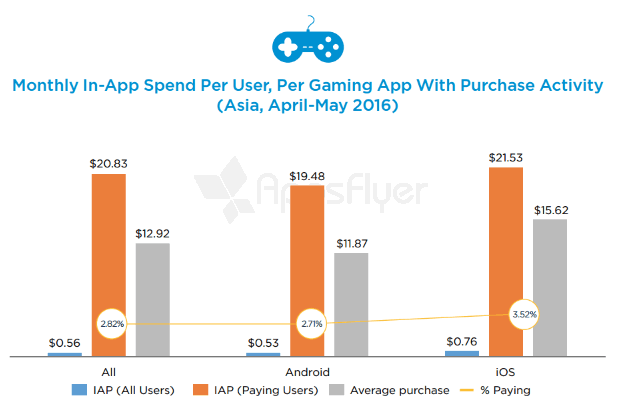
There are good news however. Some regions have significantly higher spend, like Asian users:

2016-07-Asian-gamers-spend Feel like donating your money to Facebook? Consider this first

That means for gamers in Asia, you can recover the average cost in about 4-6 months. However, in Asia there are far better paths to market for installs than Facebook. First, there are a huge variety of alternative app stores, like the T-Store, Mobango, 9Apps, 1Mobile and more. Second, CPI campaigns for these countries can be significantly cheaper than going through Facebook. We have a strong CPI offering for the region just here at CodeNgo.

Of course, as Appsflyer points out, the solution of focusing on Asia (or other regions like Latin America) is not that simple. The market is vast, business models (including price points, user behaviour on paid vs free, etc) varies widely, and you may have to spend on localization as well – at a minimum on your marketing. Clearly, no better time to build a small global business though!

Posted by:


Only a few years ago, game makers were still haunted by the grim specter of Nintendo’s massive failure, the Virtual Boy. But in 2012, the launch of the Oculus Rift Kickstarter threw the development of games into a frenzy—every major tech company scrambled to build their own VR headset in order to stomp out the competition.

by Gabrielle Montoute

Whether you like it or not, VR is the next big trend in gaming, and tech companies are flooding the market with headsets of all shapes, sizes, and tech specs. Everyone is raring to jump on the VR bandwagon by buying their first headset, but first you should know what you’re getting into.


HTC Vive

With a price point of $800, the Vive is the most expensive VR experience on the market. The headset is packed with two controllers as well as the Vive’s patented infrared sensors which allow you to move safely around your living room without walking into walls or hitting your knee on the coffee table.

Along with Vive’s partnership with Valve, there has been speculation that the system will support the long-rumored Half-Life 3, so if you’re desperate to continue the adventures Gordon Freeman, the Vive may be worth the steep price.

2016-05-23-VR Everything you need to know before you purchase a VR headset

Oculus Rift

Oculus Rift was the Kickstarter heard round the world, rocketing 18-year-old tech guru, Palmer Luckey, to stardom in a matter of days. So, if you’re looking for a tried and tested product with name recognition, the Oculus may be the system for you. The headset, with free Xbox One controller included, will run you about $600, but if you want the Oculus Touch controllers (to be released later this year) you’ll have to pay extra.

That’s in addition to the upgrades you will probably need to make to your PC: the suggested specs for the rift include an incredibly powerful (and expensive) graphics card and processor, as well as at least 8GB of RAM. Mounting hype over a four year period also means the waitlist is long, so you may have to be content with your regular old PC for several months before your order arrives.

Oculus’ partnership with Facebook may make you a little uneasy, but if you’re looking for a powerful machine that will stay relevant and stable for years to come, Oculus is the right choice.


Playstation VR

If you’re a dedicated Playstation gamer, then you can’t lose with the Playstation VR, to be released October 2016. Although the headset has a lower screen resolution than some of its counterparts, it also boasts a record 120 Hz refresh rate meaning lower latency, virtually eliminating motion sickness.

PSVR also has some of the best exclusives on the market—Star Wars: Battlefront, Until Dawn: Rush of Blood, and a new Pyschonauts standalone will be only on Playstation VR. Having a VR headset as an accessory to a console means lower cost and most importantly no spending extra time and money upgrading your system.

Being an early adopter can be exciting, especially when what was once the stuff of sci-fi movies is being actualized by tech companies all over the world. VR is the next big step in the gaming industry and the tech will only get better as more and more companies develop and release their products. If the meteoric rise of VR continues, virtual reality systems will soon become a console standard, so it’s time to get in on the ground floor.

Posted by:


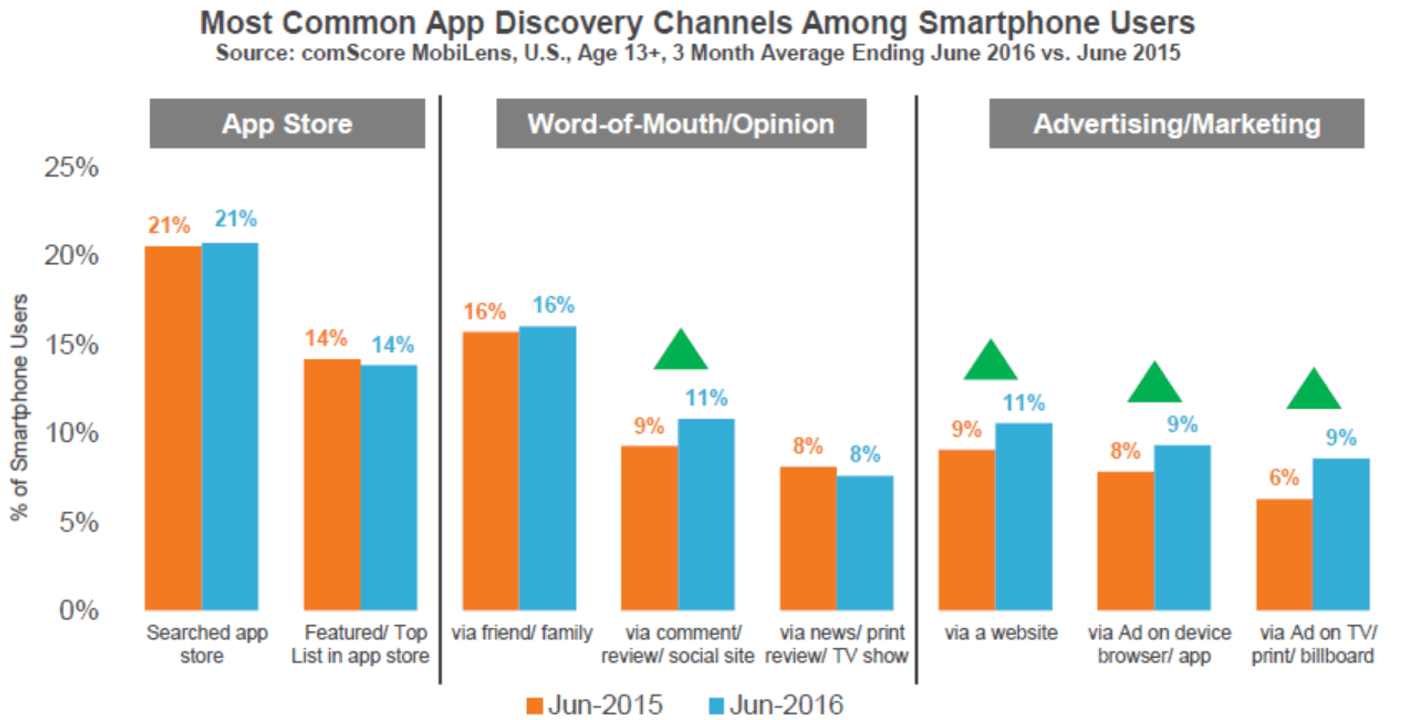
Today, the Apple App Store and the Google Play Store pack three million mobile apps. Consumers are spending 85 percent of their smartphone time in mobile apps, but only five of the daily mobile user’s apps experience heavy use. What gives?

by Sophorn Chhay

Failed retention, mostly, is responsible for the split dichotomy of app use. Often, most users downloading mobile apps don’t continue use after the first week. If you’re marketing your mobile app, you should prioritize retention over acquisition. Your brand depends on it, and for a few good reasons.

Reason One: Repeat App Users Offer the Most Revenue

It’s a simple mathematical equation. 80 percent of a business’s revenue is pulled from 20 percent of its existing customers. Mobile app marketing can be fickle, but a majority of gained revenue comes from day-to-day app users. App developers are shoveling money into advertisement campaigns, and they’re acquiring users who only constitute a fifth of their revenue. In 2016, word of mouth will serve your strategy more than initial outreach.

Reason Two: Repeat Users Use Opt-In Services

Today. 79 percent of mobile users rely on opt in mobile app and SMS services to assist the purchasing process. Acquisition fails to rake in the numbers of a good retention strategy. Even if your business’s opt-in services are SMS-centric, your mobile app’s ability to keep customers interested will power your opt-in baseline. To influence customers, you need to maintain customers in both app use and ongoing benefits.

2016-05-10-Retention-Source-Mr-Goodacre Why Retention is Superior to Acquisition in the Mobile App Marketing World

Reason Three: Deep Linking is Winning

If you’re an app developer, fueling deep links with retention should be a go-to strategy. In fact, staying on top in Google’s ranking system is often enough to secure a good amount of page views. App installs, while important, aren’t necessarily a business’s most-targeted goal these days. Deep linking is taking over, and it’s being powered by ongoing use.

Users click on apps for specific reasons. They browse the web, find an app and download it. They will, however, turn away approaches if an in-app experience fails to “capture” them. For this reason, app creators are using deep linking and SEO to maximize in-app use. Initial acquisition, while powerful, can’t begin to touch the importance of retention when entire Internet marketing strategies are at the helm.

Reason Four: In-App Messages Cement Engagement

Did you know 34 percent of mobile users abandon apps because of lost interest? Fortunately, the mobile marketing world has answered with in-app messages to boost engagement. Updates, reminders and personalized greetings, a byproduct of SMS marketing, are giving retention-focused companies a huge edge. Every time the consumer opens an app, they’re faced with a plethora of reasons to leave. Real-time alerts boost outreach campaigns. More importantly, they enhance the user experience to a point of mass integration.

Reason Five: Double Opt-In Strategies are on Fire

Automated mobile marketing providers like Trumpia are implementing retention-centric solutions, and they’re boosting business databases with relevant, real-time tools made to please mobile carriers. By opting in with a simple “yes” or “no,” customers effectively tie their texting experience to their mobile app experience. Consumers will always text, and they’ll stick with a mobile app capable of offering ongoing company support.

Assuming your mobile app offers unique utility, customers will stick around. Sure, they might have “flings” with other, interesting apps, but they’ll stay with providers able to create memorable, consistent experiences. Your mobile strategy has a long way to go, so you should power it with sustainable practices. Take advantage of the mobile world’s latest, greatest innovations, and stay up to date with the trends consumers care most about.


What’s Next?

How do you ensure that your customer is getting the best mobile experience possible when interacting with your brand? Make sure to share them with us in the comments below. I would love to read them.


Author Biography

Sophorn Chhay

Sophorn is the marketing guy at Trumpia, the most complete SMS software with mass text messaging, smart targeting and automation.

Follow Sophorn on Twitter(@Trumpia), LinkedIn, Facebook and Google+

 

Posted by:


We’re proud to be supporting the new developer survey run by our friends at VisionMobile! This is the 11th developer survey and it’s entitled Developer Tools Benchmarking – as you can understand, the focus is on developer tools.

The survey features questions on topics like programming languages, platforms, app categories, tool categories, revenue models, IoT verticals – and, of course – tools! It’s a survey made by developers, for developers – so the questions are very relevant!

Whether you’re looking to share your thoughts with the dev community, find out something new, contribute to the leading developer research – or win a great prize – this is the survey for you!

Participants can win one of the tens of prizes available, including an iPhone 6s, an Xperia Z5, a Nexus 6P, and more. VisionMobile will also share the survey findings with you, and show you how your answers compare you to other developers in your country.

TakeSurvey Heroes of coding unite! Contribute to the biggest Developer Economics Report


Posted by:


A deep link is any URL that takes you to content within a website or app, rather than to the homepage. They can be used to bring the user from one page of web content to another, or from web to app or, as is becoming more common these days, from app to app. In the case of the latter, this is known as mobile deep linking, a tactic which has been used increasingly as mobile commerce and the use of mobile apps have expanded. So, why use deep links and how can you implement them?

by Olga Grigorenko


Step #1. Identify the Value of Deep Links


Deep links drive user engagement.

This is a factor which is tremendously important to the success of any website. As explained above, a deep link provides a direct route from one page to another, bypassing unnecessary content and funneling the user directly to the targeted page and/or app.

This streamlines the process, making it not only easier for the user but also ensuring that they go directly to the content you’re pointing them to. If you’re trying to attract new users to a new app, deep links can allow them to get there within the app store, as opposed to exiting their browser window and having to search for it themselves.

Time is money, and convenience is a valuable commodity.

Deep links increase acquisition and retention.

These are two of the most essential marketing goals of any company. If the end-goal of your site or app is to obtain new customers and keep them (as it should be), deep links can directly help you reach that goal.

One thing that marketers have learned when targeting millennials, is that those customers value ease and utility. Deep links offer both of these assets, creating a better user experience that will attract and retain your customers.


Step #2. Building Your Own Deep Links

Develop deep links from scratch.

If you’d like to build your deep links internally, your developer will first need to identify the URI (Uniform Resource Identifier) of each page in your app. From there, they’ll need to build and develop the code that will direct and launch the intended action of the deep link.

A useful resource to direct your tech team to is MobileDeepLinking, a guide which provides developers with implementation details as well as standard framework to help them get started.

Deep link tools for developers.

If you would like to use existing software to develop your deep links, there are a few great options out there that will lend a helping hand to your techies. A few big name solutions such as AppLinks from Facebook and AppIndexing from Google are two widely used options.

Other startup solutions are cropping up as well, offering customers a variety of options. All of these solutions are intended for developers (since they require a knowledge of coding), but they nonetheless provide invaluable framework which will ensure that you are making the most of your deep links.


Step #3. Set forth and unleash your deep linking potential


Build your deep links and let them work for you.

Now that you know the why and how, you can get started on implementing deep links in order to power up your site or app. Whether you are a developer or a marketer, understanding the capabilities of deep links will help you make the most of your marketing efforts and ensure increased usage and visibility.

By directing users to content other than what is on the home page, you will also increase the authority of your entire site, which is an important SEO strategy for most websites. With the number of various options out there to help streamline and simplify deep linking across multiple platforms, you are certain to find the right fit for you and your team.