From Samsung:
| Dear Seller This is the Samsung Apps Seller Office. Thank you for your continued support of the Samsung Apps Seller Office.The changes detailed below will be introduced as part of our ongoing commitment to service improvement. |
||||||||||||||||||||||||||||||
|
||||||||||||||||||||||||||||||
From Samsung:
| Dear Seller This is the Samsung Apps Seller Office. Thank you for your continued support of the Samsung Apps Seller Office.The changes detailed below will be introduced as part of our ongoing commitment to service improvement. |
||||||||||||||||||||||||||||||
|
||||||||||||||||||||||||||||||
There is nothing better than having an app on your phone that can make a difference to your life. No, we are not talking about the fame of leading the scoreboard in Angry Birds or Temple Run, but about the best premium finance apps that you can download onto your android device and start using immediately. For a small fee, you can enjoy a range of features not available on free applications that will help you do an even better job of personal finance management.
Our infographic does not just look at the personal budgeting side of finances, either. We look at how you can use an app to manage any debt repayments as well as your work expenses. Another app will appeal to those who are interested in investing in stocks and shares, but do not know where to turn to find the best information. This infographic shares the best premium finance apps for android that could change your life immediately.
James is a student interested in various areas of the financial industry. One of James’s relatives told him he was looking for reliable accountancy companies in the UK, inspiring him to write a report as part of his studies around who are the best ones.
Success in in-app payments require a great deal of things coming together. First, your app has to be compelling and the item the user purchases has to be priced right and provide a value to the user. Then the payment experience needs to be seamless.
In the now over a decade long history of mobile content, mobile billing has been an important component to achieve a great payment experience. The simplicity of not having to fickle with user IDs or password, not having to put in a credit card number, and the speed of payment through sending an SMS enabled the entire ringtone and later game and content market. Mobile content, and also in-app billing is typically priced fairly low, making the purchase an impulse buy, which makes the ease of payment so important:
Dominant Virtual Item Sticker Price in Mobile Games
Source: Virtual Economists Ltd, 2012
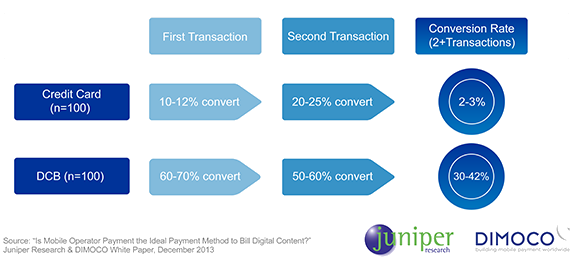
The “grandfather” of payment methods enabling this was premium SMS, or PSMS. PSMS is still around, but increasingly it is falling out of favor, and most recently operators in the US said enough is enough and decided to scrap PSMS altogether. Rogue content provider charging weekly subscriptions to users who thought they were paying for single items, questionable sign up mechanisms (crazy frogs anyone?) and the true cost of signing up shown in ultra-small print flashing on the screen not only caused need for detailed legislation in each market, but policing by telcos and high costs associated with complaints and refunds has made it a “love/hate” service the operators have provided. This (along with sheer operator greed) caused pricing to be outrageous, often ranging from 40-70% of end user price, up to 90% in some markets, however given the simplicity for the user to pay, content providers simply could not ignore it. The simplicity translates directly to much higher conversion rates, highlighted by recent research by Juniper:
Billing Mechanism Conversion Rate Comparions, Low Value Purchases: Credit Card vs Direct Carrier Billing
So while PSMS may be slowly killed by operators around the world, the focus has shifted to direct billing. Direct billing is superior in many ways:
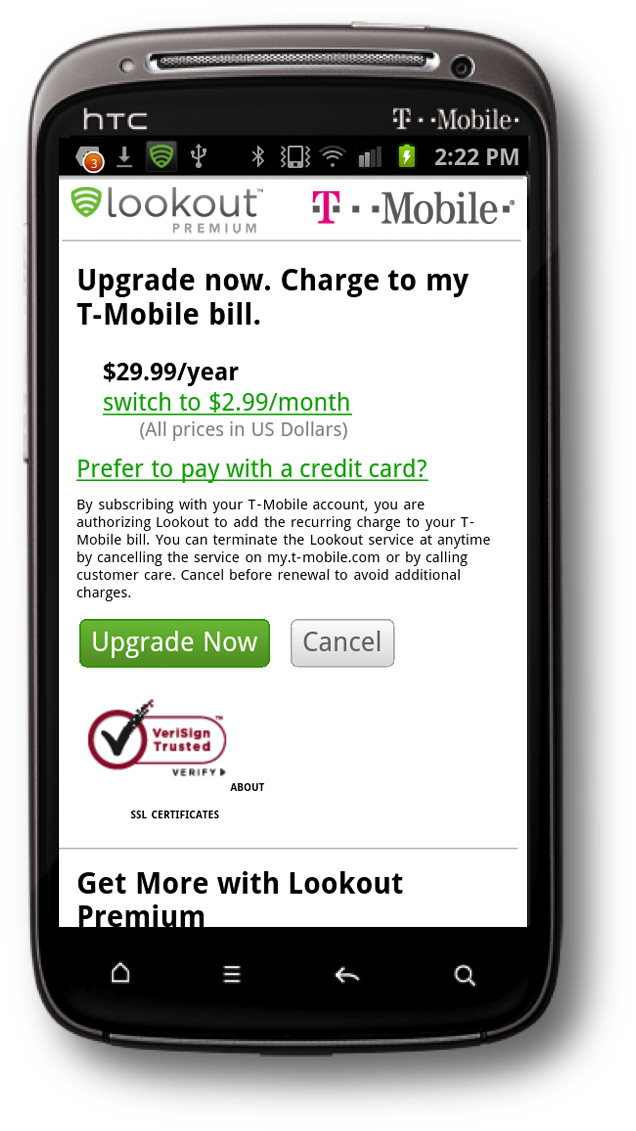
=> It allows for a true one-click experience, as shown in the example to the left (you can actually see two options, but clicking the green button to pay right away is clearly superior). There is no need to send or receive an SMS. This is the absolute key to convert impulsive app users
=> The rates are significantly better. US payouts on PSMS ranged from 50-55% typically, while payouts for mobile direct billing is +80%.
However, there are still a number of issues needed to be resolved before mobile direct billing wins the battle for app developers.
Multi-SDK issues needs resolving
Supporting in-app billing across app stores and across markets require multiple integrations. This is a pain for developers, and solutions are needed. We have previously written about players like Lotaris and the OpenIAB project from Open Platform Foundation. Companies like Bango and Fortumo also specialize in this, and have made deals with multiple app stores.
Sign-up processes are complex and need to be made simpler
Different countries have different rules for direct billing, but commonly telcos are eager to avoid the mistakes they made when rolling out PSMS. They cannot solely rely on aggregators to police the market, so for instance in the US they put tight requirements on developers and merchants to provide complete list of all the SKUs sold. Even though more and more developers use virtual currencies, so there is really only a few SKUs to maintain (like “Gold”), the need to constantly update and change your game to maximize adaption and revenue will inevitably require you to change your SKUs often. How this will scale we cannot possibly see, and surely there must be better onboarding/signup processes to come.
Taxes need to be simplified
In markets where VAT has to be charged on digital goods, like most countries in Europe, you are as a merchant subject to double taxation. The telcos will deduct VAT from the payment amount, and you as a merchant will also have to submit VAT to the European governments (or the app store or billing partner has to on your behalf if they act as the merchant of record). With European VAT ranging from 17-26%, the cost is significant, and if avoided should bring mobile direct billing down to the 15-20% range across the board.
The cost sweet spot needs to be found
While PSMS certainly enabled the market for mobile content, the low payouts pretty much forced a subscription model as content providers needed to ensure users bought more than one item to recoup user acquisition costs. So the key to unlock a healthy market for content is most likely a minimum of 70% to the developer (while experiences from Japan and Korea has shown that larger pies of 80-90% unlocks an even larger market). Hopefully operator greed can be avoided, and lessons learned enable less consumer complaints and costs of managing the billing, so operators can charge more normal rates.
These days of course the onus is on the app developer to ensure multiple in-app purchases rather than subscriptions to pieces of content, but the more developers keep of the pie for each purchase, the more the market will grow. As not only co-founders of CodeNgo but fathers of small kids who love playing games we even hope this can possibly reduce the need somewhat to charge for absolutely everything within a game, to bring a bit more peace at home. One can always hope.
Whether you are getting ready for the big day or are planning a proposal in the not so distant future, it helps to be prepared. So many different aspects of planning go into the traditional engagement process and it can be stressful if you do not have all of your ducks in a row when it comes to party planning, event bookings and the inevitable accessories that make this time in your life special. Many people used to hire wedding planners in order to handle all of these tasks, as information and the ability to organize was limited by technology. These days, however, it has become much easier to plan and organize through the use of technology, with mobile applications now playing a key role in the process. In the following article, we will discuss three must-have Android applications for wedding engagements and will explain how each one can help make the process easier.
Wedding and Engagement Rings

If you have not yet picked out your engagement and wedding rings, then there is a good chance that you have not yet popped the question. An engagement ring is the signifier that a commitment has been made and most people prefer to have an engagement ring ready from the start. Even if you do not wish to purchase an engagement ring, a wedding ring will ultimately be needed. The Wedding and Engagement Rings app for Android is a prime utility that can help make this process easier for those who need help with ring selection. Inside the app, users will find hundreds of unique and handcrafted rings that can help inspire and can be used as points of reference with local jewelers. Photos can also be easily shared with family and friends for a second (or third) opinion. Available for free, the Wedding and Engagement Rings app can be downloaded from Google Play.
https://play.google.com/store/apps/details?id=com.karruti.alianzasdeboda
Engagement Gifts

Whether you are a bride-to-be or someone who will be attending a wedding shower, the expectations of a gift for that special day is a given. Anyone who is invited to your wedding or otherwise is a close acquaintance will need to know the best way to gift you something: this is where the Engagement Gifts app can help. Users will be able to learn about the common events that occur during an engagement, how to pick out the proper gift, where to sign up for gift registries and much more. Available from Google Play, this free application can be a godsend for both those who are engaged and those who know someone who is.
https://play.google.com/store/apps/details?id=com.a17214849695109fcfa5d73c5a.a32927358a
Engagement 101

The final app on our list is Engagement 101, which can be downloaded for free from Google Play. Anyone who is planning to get hitched can gain valuable information from this application, which covers concepts such as wedding ring selection, registry planning and venue selection. Proposal ideas and tips for planning the perfect atmosphere can also be found within the app. A digital magazine can also be accessed through the app for more information.
https://play.google.com/store/apps/details?id=fr.sedicom.Engagement101
License: Creative Commons image source
License: Image author owned
License: Image author ownedThis article is authored by Jeremy Adler, a freelance blogger currently working for Lior Diamonds, retailers of GIA certified diamonds. Jeremy is an animal lover and volunteers at the SPCA on weekends..
From Samsung:
| Dear Seller Thank you for using Samsung Apps Seller Office; we deeply appreciate your support for our service.The changes detailed below will be introduced as part of our ongoing commitment to service improvement. |
||||||||||||||||||||||||
|
||||||||||||||||||||||||
| If you have questions, select Seller Office > Support > Contact us for inquiries. The Samsung Apps Seller Office continues to be dedicated to providing better services for our valued customers. |
||||||||||||||||||||||||
From Opera:
Dear App Developer,
We are happy to announce our partnership with OpenMobile World Wide, Inc. OpenMobile developed a game changing technology, known as Application Compatibility Layer (ACL)™. ACL enables Android applications to run seamlessly on other operating systems with native performance, zero latencies, and no expense or efforts!
To put it simply, ACL technology allows your Android apps to run on other non-Android operating systems. The best part is that OpenMobile’s ACL technology enables your apps on these platforms with NO additional work and NO cost to you.
Even more, OpenMobile tests your apps to ensure they run smoothly on each of the ACL-enabled platforms distributed by their OEM customers!OpenMobile will be distributing your applications to devices running the Tizen operating system, as well as the webOS operating system. In addition, there are several additional operating systems and devices to be launched in the near future.
Thanks to our partnership with OpenMobile, your apps will automatically be available through OpenMobile’s distribution channels unless OpenMobile receives a notice from you (customersupport@openmobileappmall.com).
We are pleased to provide you with these new and very exciting distribution channels. We look forward to delivering continued consumer downloads and purchases!
Thank you!
From Samsung:
| Dear Seller This is the Samsung Apps Seller Office Team. Thank you for your continued support of the Samsung Apps Seller Office.Please note the following changes to the terms and conditions for the Samsung Apps Seller Office. Terms and Conditions of the Samsung Apps Seller Office will be revised as of 12/01/2013. Sellers are encouraged to read the revised terms and conditions to avoid any inconvenience when using the service. The details are as follows: |
|||||||||||||||||||||||||||||
|
|||||||||||||||||||||||||||||
From Samsung:
| Dear Seller Thank you for using Samsung Apps Seller Office; we deeply appreciate your support for our service. |
|||
|
by Matthieu Saint-Denis
Even if F2P business models have existed since 2002 on mobile – and I was lucky enough to belong to the company that pioneered it on Java – we have to acknowledge that it’s only been widely adopted by developers in the last 3 years, when Apple brought in-app purchases.
Since then, the games industry has been obsessed by the 3 goals: acquisition, retention & monetization. It seems to us that one of those 3 pillars, monetization, is less advanced than the other ones. As acquisition & retention methods have been previously deeply explored by web community players for a decade, monetization has been less sophisticated as it has relied mainly on the declining ads business.
The game monetization model today is based on 2 major sources of revenues, advertising and in-app purchase, however we’d like to emphasize an almost untapped third source: merchandising. For many of us, it’s still (almost) zero but for some others, such as Rovio, it’s 45 % of their revenues… which means there is definitely room for improvement!
To put things in perspective, let’s take a look at what merchandising accounts for in the entertainment industry:
In the video games industry, despite some shiny examples like Rovio and also Final Fantasy, Raving Rabbids, Moshi Monsters, etc. we are still far from those figures. There are some obvious reasons for that and it is pretty much on the supply side: just remember your last visit to a museum or your last dinner at a “grand chef” restaurant. You’ve been delivered a great service and at the end you’ve been offered some physical goods to buy as an additional pleasure. The museum shop is systematically placed at the end of the tour (where you can’t avoid to visit it), and at the cash desk of the restaurant you can find the books and the videos of the “Chef”. They have understood that it’s when you feel happy and receptive towards their content that they have the best chance to sell you something.
We, game developers, have not yet understood this. Some make some good old non-personalized t-shirts to be found in a 3rd party website, which typically requires gamers to leave the gaming experience to buy them. And this is our first mistake. If we agree that gamers have more chance to buy merchandising from the game when they are proud and happy, then we should embed the shop within the game. It is the first obvious rule to apply… just like Jurassic Park merchandise madness has started with street sellers on the pavement in front of theatres. That’s what we call IN-APP MERCHANDISING. It may be one of the next big things for monetization.
But it’s not enough. One of the biggest trends of our industry is the personalization of the gaming experience. Nowadays you will find that in many games, players can deeply customize their character, car, village, farm, city, etc. It makes gamers all unique and creates a deep link between the users and the game. And it’s a great opportunity for merchandising, because finally production technology of customized goods is able to quickly and at reasonable cost produce fully unique products:
It leads us to a straightforward conclusion: we believe that the combination of an embedded shopping experience and a personalized custom goods offer can easily generate from 5% to 10% of additional revenues for all kind of games and obviously even up to 40% when the game is well suited to merchandising (character driven, ready to print 3D, etc.)
At FabZat we offer a full service chain, starting with a plugin ready to be embedded in an iOS or Android code and taking care of production, billing, shipping and customer care. As we 3D print ourselves we guarantee high quality of any products leaving our workshops. While we deliver worldwide, we position ourselves as the first “in-app merchandising” service provider in the mobile game industry. We would be delighted to get your comments and questions at matthieu@fabzat.com. Thanks for reading, talk soon.
Mathieu Saint-Denis is the CEO of FabZat. He has a long track record in consumer marketing, and over 10 years of experience the mobile industry.
From Samsung:
Dear Seller
Thank you for using Samsung Apps Seller Office; we deeply appreciate your support for our service.
To stimulate interest and promote development in the Samsung Apps ecosystem, we will introduce a new profit distribution rate to better benefit our Sellers. According to the current terms and conditions, the profit distribution rate (including In-App Purchase profits) from the sales of applications is 70% for Sellers and 30% for Samsung. Samsung will temporarily adjust this rate to 80% for Sellers and 20% for Samsung from November 1, 2013 to April 30, 2014. Sales of paid applications are not subject to this profit distribution rate, and this rate applies only to the sales profits of In-App items of applications using In-App Purchase 2.0. The new profit distribution rate will be applied beginning November 1st for all registered applications using In-App Purchase 2.0. If your application is not yet using In-App Purchase 2.0, please update and register your application. (If the application is distributed after November 1st, it takes 3 to 4 working days for the new profit distribution rate to be applied) You can find information about In-App Purchase 2.0 at the following URL.
http://developer.samsung.com/in-app-purchase