Posted by:


Monetizing your app through mobile advertising doesn’t have to mean cluttering your app with dizzying messages or disturbing your users with unwanted distractions. A good monetization strategy puts the user first, and takes into account the user’s app usage journey to determine which ad formats to use and where to place them within the app to get the best response.

By Dale Carr, founder and CEO of Leadbolt

Not all ad formats are created equal. Mobile ad units are designed to work their best when placed in specific areas of your app or served during distinct levels of app usage. The ‘App Usage Cycle’ – a term coined by Leadbolt – describes the main phases of App Usage and is defined by Entry, Engagement and Exit.

ENTRY

Entry describes the moment when a user first launches the app. During this time, the user is not yet fully immersed in activity, and this is a great opportunity to attract your user’s attention with these ads styles:

INTERSTITIALS
Visually compelling full-screen interstitials are best placed when an app is newly opened. At this stage, users can easily complete a call to action without leaving the app, and without disrupting their experience once fully engaged in app use.

VIDEO ADS
Video effectively captures attention before app use, and in-between game levels or app transitions.

IN-APP ALERTS
A concise offer alert can pop up in the app at any point during app usage, but it can be particularly effective when served as the app is opened – when users are not yet fully immersed in the app activity.

2014-07-01-Leadbolt-ad-formats A User-First Monetization Mindset

ENGAGEMENT

During Engagement, users are in the middle of enjoying the app. They are at their most focused during this stage. To avoid unwelcome distraction or interruption, ads should be targeted, relevant to the user’s interest and served up in an engaging format.

MOBILE BANNERS
A mobile advertising mainstay, banners are generally accepted as users expect to see some level of advertising in exchange for downloading an app for free. Banners are benign, but also not as compelling as other formats, as mobile users have become somewhat desensitized to their presence.

AUDIO ADS
Audio Ads rely on an audio message to capture the user’s attention, rather than a visual disruption. Like a radio ad, the user hears the message while continuing to use the app successfully. Some Audio Ads offer gyroscopic functionality, prompting users to shake the device to interact further with the ad, offering a fun spin to the experience.

FLOATING ADS
Floating ads offer a game-like experience where users are tempted to pop the branded bubbles that float across the screen. The novelty, combined with custom bubbles that match the app’s theme make this format fun to play.

APP LISTS (OFFER WALLS)
Typically the least disruptive of all ad units, App Walls generate high revenue. App walls work well because they provide a benefit by suggesting more apps similar to the one the user just used. For games especially, app walls are relevant to the users’ interests and offer an experience the user is known to already enjoy.

EXIT

This is when users have finished their app activity and closing the app before transitioning to the next phase of using their device.

APP LISTS – see above.
App Lists also work well during the EXIT phase, as users may be looking for additional apps to extend their activity after their first app experience has come to an end.

RE-ENGAGEMENT ADS
A powerful way to drive repeat app usage, these ads remind users of an app that is already downloaded to visit again soon. Users can return to an app by tapping on a branded design.

NATIVE ADS
For app developers who prefer original, one-of-a-kind ad experiences, Native Ads can match the unique look and feel of your app, as well as fold into the app value proposition, delivering a seamless ad experience for your end user. App developers can get started easily with Leadbolt’s direct-connect API ad-serving.

As a general practice, it’s always best to rely on data. Use the analytics and reporting tools offered by your ad network to follow the trends and ad performance happening inside your app. Test to see which advertising styles your users respond to and optimize on those formats. We hope this tour through the App Usage Cycle is helpful, but please know that we are here to help you get the most from your mobile monetization efforts. Visit us at Leadbolt.com for more information or to get in touch.


2014-07-01-Dale-Carr-Leadbolt-240x300 A User-First Monetization MindsetRecently named Ernst & Young’s Australian “Entrepreneur of the Year” 
for Technology, Dale is a thriving entrepreneur and technology expert with over 10 years in the mobile industry and a track record of success. His previous ventures include co-founding a mobile technology company recognized as Deloitte’s Fastest Growing Technology in Australia and 3rd Fastest in Asia Pacific, as well as serving as CIO of a UK technology start up that was sold to a major retail group.


Posted by:


It’s that time of year, when a barrage of free statistics come at you from Mary Meeker at Kleiner Perkins Caufield and Byers (KPCB). The Internet Trends report is undoubtedly one of the most influential reports out there – and hey, it’s hard to beat free.  But what does this all mean for you as an app developer? We’ve looked at it with the eye of developing an app business, and it does indeed look very good.

Mobile usage up = more of everything

The report points to that on a global basis, mobile usage accounts for 25% of the overall consumption of content on the web. For Asia and Africa, this is well over a third:

2014-06-17-Mobile-usage-v-web-usage What the Internet Trends means for the mobile app developer

In some markets, especially Western markets, this is somewhat driven by a massive growth in tablets, and globally there are more than half of many tablets shipped as laptops. For a mobile app developer this is an opportunity and a challenge. It’s an opportunity because the massive growth will support a huge explosion of app sales – it’s a challenge because it means you are increasingly managing a global business and one that is fragmented on device sizes (big vs small screens) and business models.

Mobile app revenue > mobile advertising revenue

KPCB pegs paid revenue as 69% of the mobile app monetization. This is good news in two ways:

1)      People paying for your product means there is an appreciation and willingness to pay, and a current view on mobile content as being premium.  This means cable is beating network TV. For now

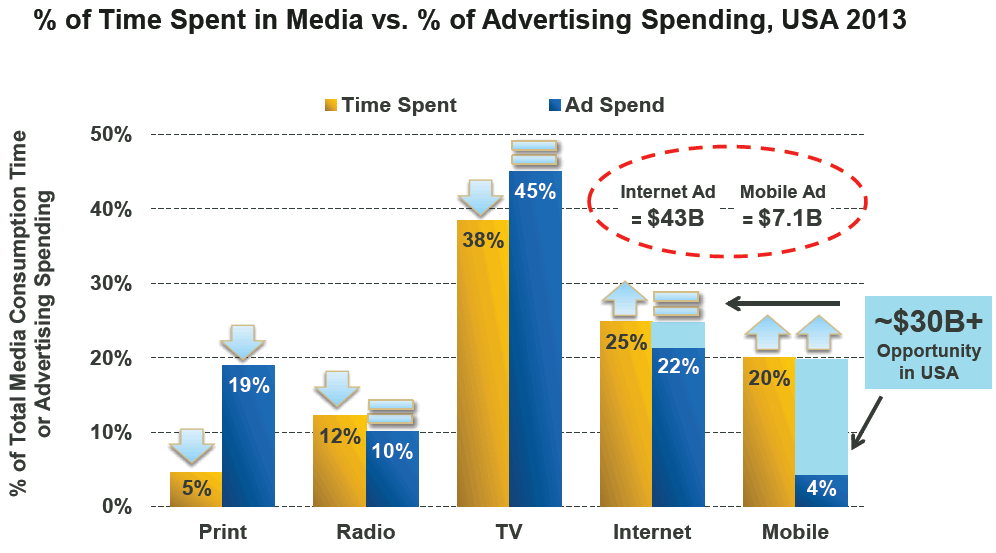
2)      The fact that mobile advertising is so low is encouraging, because there is a huge gap in ad spend online vs mobile when you compare to total usage:

2014-06-13-Time-spent-in-Media-as-percent-of-ad-spend What the Internet Trends means for the mobile app developer


This implies of course that there is a huge amount of dollars that should be spent on mobile, which presumably means more advertising revenue available for everyone.

TV = Smart + Multi-screen

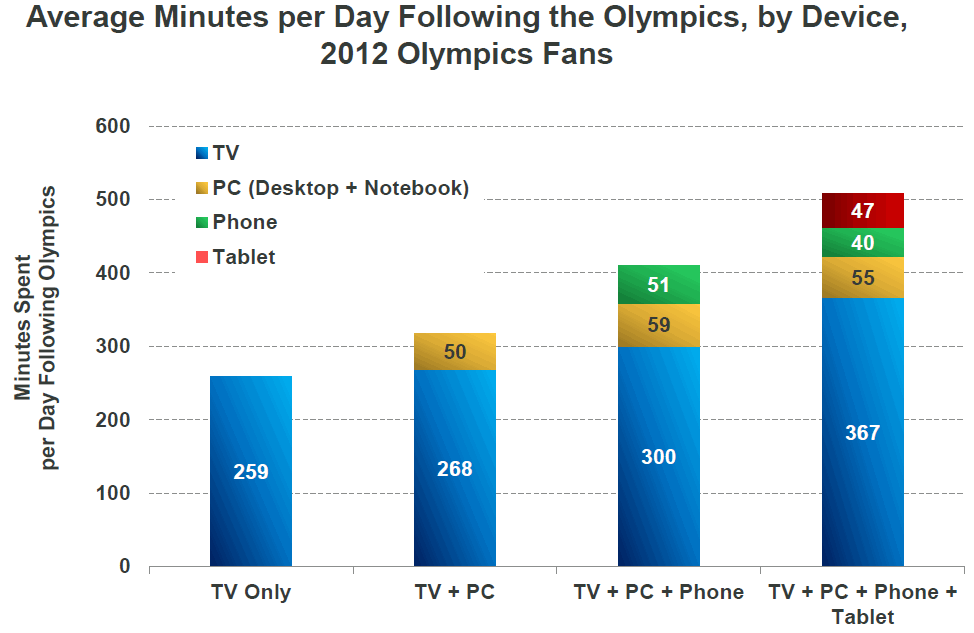
We’ve previous mentioned that a huge app battle ground to come will be your TV. This can mean apps and app stores tailored for Smart TVs, or it can mean apps that are designed to work in and around TV content.  Data from the 2012 Olympics showed that users who also watched while using their app were much more engaged overall:

2014-06-17-Avg-time-spent-following-Olympics-Source-KPCB What the Internet Trends means for the mobile app developer

The merging of TV with other platforms has many implications for app developers. Not only can you create apps that take advantage of TV content (whether it’s quiz games based on content, interactivity/social with something live on TV, etc), but you can easily see TV as an engagement or discovery channel for your app. It is not farfetched that users soon will among an apps permissions say they allow your app to track what you are watching on TV and send notifications to the TV screen.  So for instance when you are watching sports, you are reminded you have a really cool football game on your phone – at a time when you are possibly more likely to fire up the app.  This can help not only app engagement and usage, but also discovery, as you could easily see where TV real estate could be used for personalized ads or peer to peer recommendations (i.e. learn which app your friends are using while watching the Olympics in real time on the screen, similar to what Spotify uses Facebook for now). This is all coming in the not too distant future.

There are also some really cool cross platform plays spanning TV, mobile and PC that have been successfully rolled out. One of our favorites is Wie is Tim :

This particular concept showed that 1 in 6 of the TV viewers downloaded the app. There were more than 280,000 downloads and it achieved #1 position in the iTunes store and #8 worldwide. On its series return GTST saw a 25% rise in audience share on television.

Now this type of content is not common place yet, due to fairly high costs compared to just producing an app or a single channel experience, but the level of engagement is simply amazing. And as in anything, costs are increasingly coming down thanks to companies like The Project Factory and their Appisodic Platform, which means soon we will get more holistic entertainment experiences utilizing every device.

China = Big. Really big.

It’s kind of been something most people know – the fact that China is growing and becoming a huge tech market. But the fact that 4 out of 10 of the world’s busiest sites are Chinese is staggering:

2014-06-17-Top-global-internet-properties-Source-KPCB What the Internet Trends means for the mobile app developer

One can only being to fathom how big this is when looking at handset makers Xiaomi’s sales record on singles day (equivalent to black Friday): 200.000 handsets sold in 3 minutes.  On the same day, Alibaba’s T-Mall retailed for $1 billion in 50 minutes.

What does it mean for a developer? Well, you may start thinking of how you can play in this market. We are, and if you are seriously considering making it in China, get in touch.  Another thing to think about is that there are a serious amount of developers in the country. And they will be looking to go international as their home market gets crowded. When that happens, you will see competition on a very different level than today.

CONCLUSION:  While some developers are struggling today, and some are thriving, the opportunities for all will continue to expand. As a developer though, you increasingly need to manage a global business to be able to capitalize on the opportunities. This means localizing language, content, marketing and distribution. At CodeNgo it is our mission to make this part easier and easier.

Posted by:


Major policy change from Samsung (taken from their newsletter):

[Seller Office] Application submission policy changes
Dear Sellers,Thank you for using Samsung Apps Seller Office.

This is to inform you that Seller Office’s app submission policy will be changed from July 1, 2014. the changes are listed below.

  • 1. When submitting new app in Seller Office, you are required to submit app that was developed using Samsung SDK.
  • ※ Samsung SDKs are the tools that help sellers to make apps using Samsung device-specialized functions such as S Pen, Finger Print, Gesture, Motion and more. Please visit SAMSUNG DEVELOPERS (http://developer.samsung.com/) to download Samsung SDKs and obtain additional information.
  • ※ In case of existing apps registered in Seller Office, the apps can be updated without using Samsung SDK.
  • 2. Samsung Seller membership will be terminated for those who registered before February 20, 2014 (GMT +09:00), but have not submitted any apps to Samsung Apps Seller Office. (Membership termination date : June 30, 2014)
Please refer to the below Q&A for more information or contact our Customer Support team (http://help.content.samsung.com/csseller/).
Q 1 : If I submit app before July 1, 2014, should my app use Samsung SDK?
A 1 : No, the new policy will be effective from July 1, 2014.
Q 2 : Is it impossible to submit apps without using Samsung SDK from July 1?
  • A 2 : No, but you must use Samsung SDK to submit apps. however, Sellers who have separate contract or partnership with Samsung can submit apps without using Samsung SDK. if you have any question on contract or partnership, please contact our Customer Support team (http://help.content.samsung.com/csseller/).
Q 3 : If my membership is terminated, how can I obtain membership again?
  • A 3 : You can re-register and obtain a new membership after 72 hours from the most recent membership termination.


Posted by:


As developers look for new markets in which to hopefully turn their app ideas into the next Flappy Birds, the subject of China repeatedly comes up in conversation. The sheer size of the market combined with its relative inaccessibility for most Western developers given Google Play’s irrelevance there, creates a mystique about China that has many a publisher chomping at the bit to find a way in. As we prepare to extend our distribution offering into China, we’d like to share with you our thoughts on key things to consider if you’re planning on entering the Chinese marketplace.

About a year ago, AppFlood published an informative piece highlighting 10 top Chinese app stores that included the likes of 91 Hiapk, Baidu Market and Wandoujia on the list. They followed that up this year with an excellent piece on how the revenue shares breakdown in the Chinese market. Both of these pieces will provide to you the basics of how business is done in China.

wandoujia-android-games Alternative Chinese App Stores: Toppling the Great Wall
Armed with that knowledge we strongly recommend that you don’t stop there but dig deeper and take into account the following considerations as well:

– If your app has in-app purchases then you’ll need to integrate the SDKs required by the stores you plan to submit to. For games, almost every store has their own specific SDK. For non-game apps there’s a bit more flexibility;
– Does your app rely on Amazon Web Services? While they are making a concerted push into China, our resources put AWS availability at 60-70% right now;
– Do you plan to publish under your own name? Some stores will allow it and others require a Chinese publisher of record;

– Plan to localize for language and for cultural differences, especially if you’re a games publisher;
– Store reporting is in Chinese…better get a translator;
– Feature placement and promotional campaigns need to be negotiated directly with the stores;
– Do you plan on tracking and/or responding to reviews?


This is just a partial list of things to weigh as you consider entering China with you app. So, while China is quite appealing for many very good reasons, it would be foolish to underestimate the amount of work required to effectively manage the Chinese market. CodeNgo is actively working to build new services and partnerships that will reduce the barriers to supporting the Chinese market for our clients. We hope have more for you on this very soon so stay tuned!!

Posted by:


2014-05-13-ASO-professional-app-store-optimization Top 6 Quality App User Acquisition Channels for 2014
For any app publisher, acquiring new users is consistently an area of focus. For those publishers with larger budgets, trialing many different channels is of paramount importance. Medium and smaller size developers find that they need to be more creative and focused in their efforts but regardless of the size of the publisher, finding high quality users remains a significant challenge. With that in mind we’ve compiled a list of the top quality user acquisition channels based on our experience and discussions with developers.

Facebook Mobile Ads
The Facebook Mobile Ads product has taken the market by storm. Facebook’s reach plus their targeting capabilities make Facebook ads second to none as a tool for acquiring users. The downside for most developers is that the big publishers all recognize the power of Facebook ads and thus bid up the cost of acquiring users beyond the budget of most small developers. If you know who you’re trying to reach and have the resources to invest then you can’t go wrong with Facebook.

Ad Networks
Yes, I know this is a very broad category. There are a plethora of ad networks out there from large global players like Admob, Tapjoy and Leadbolt to regional networks like Vserv and a bit of everything in between. Targeting capabilities, while not at the level of Facebook, are typically pretty good. In addition, most ad networks have moved beyond the simplified banner ads that typified most ad networks several years ago and offer more native-like ad units. The key to successfully finding the right ad network for your app starts with understanding who your users and who you want to acquire. Once you know who your valued users are then you can seek to find ad network partners who can help you to acquire those users.

Cross-Promotions with Other Apps
This should be a part of every app marketer’s tool kit and should be at the top of the list for most smaller developers. The reality is that paying for downloads is expensive and the large publishers have driven up the cost on the most effective channels. Developers need to network and reach out to other developers serving the same audiences that you want to reach. Consider using tools like Xplode from Iddiction that allow you to easily connect your own apps to drive installs and also connect with other developers to grow your installs together. Whether it’s using new tools or building your own ad network with other developers the old fashioned way, cross-promotions can offer the best ROI for cash strapped publishers.

App Store Optimization
ASO has certainly become the rage over the last year or so and for good reason. With the proliferation of services like MobileDevHQ, Appcodes, Searchman and more, effective ASO strategies and tactics are easier than ever for developers to access. ASO experts like Stefan Bielau are sought after speakers at developer conferences and forums. Research suggests that over half of all visitors to app stores do not come with a specific app in mind and use the search function to find the apps that they end up downloading. If you’re a smaller developer trying to compete with large publishers on the top key search terms then you’re setting yourself up for failure. Effective ASO is an iterative process so don’t expect it to be a silver bullet. Invest some time in keyword research each week and give prospective users a better chance to discover your app. And don’t forget to have an awesome screenshot on offer when they find you!

App Localization
For far too many developers, localization is an afterthought. They build an app in English, submit it to iTunes or Google Play and check off worldwide distribution and then hope. For serious developers, app localization should be a standard part of developing your app. We recommend starting with your app descriptions to test which markets your app appeals to and then extending from there to the strings inside of the application. At CodeNgo we’ve partnered with Tethras, one of the leaders in app localization, to make it easy to translate your app at the same time that you’re submitting to app stores. Distimo and others have reported on the benefits of localization already. Take advantage of this low hanging fruit and see your app downloads soar.

Expanded Distribution
If your app were a beverage you would want it to be available wherever thirsty patrons shop. The same should be true for your app. While iTunes is the only real game in town for IOS, Android publishers have access to hundreds of stores. In China, where Google Play doesn’t play, you have no choice but to consider alternative stores. Collectively these alternative stores drive billions of downloads and the One Platform Foundation estimates that you’re more than 20 times more likely to be featured in these alternative stores than in Google Play. With services like CodeNgo available to help you manage all of these stores efficiently, there’s no reason why you shouldn’t get your fair share of those users.

Posted by:


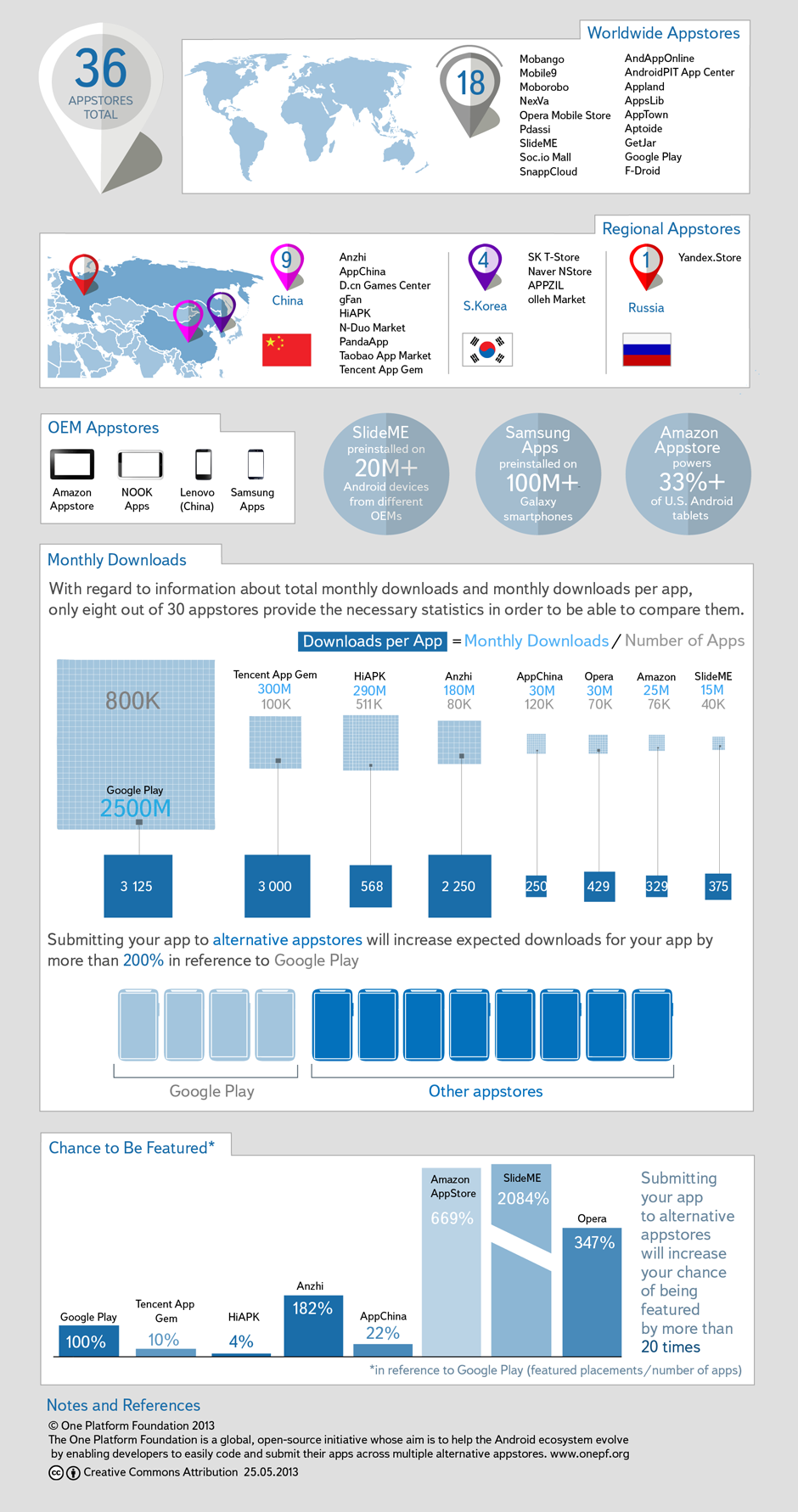
There are more than 30 different app stores for Android; for some of them statistics are available and for some of them they are not. We have collected almost all available information and have tried to answer the question:

Does it make sense to spent time submitting my app to alternative Android appstores?

Android-Appstore-Market-Overview Android Appstore Market Overview

Posted by:


Now that the new Developer Economics survey is coming to a close (make sure you participate by clicking the link at the bottom of the article!), it is a good time to reflect on some of the key messages from the previous survey. Developer Economics 6th edition was the largest ever research conducted on the app economy, with over 7000 developers participating.

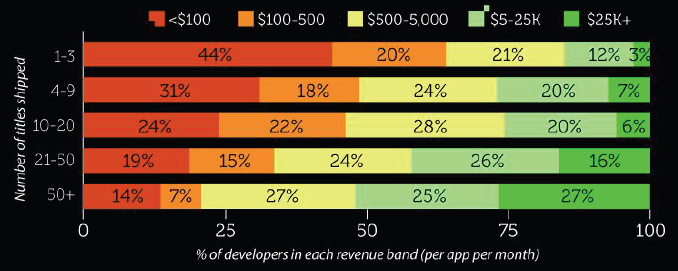
The report goes in lengthy details on developer’s choice of platform. This is of course typically lead by the revenue potential of each platform, which paints a quite dismal picture:

2014-03-25-Developer-revenue-distribution-2 Are you below the (app) poverty line?

The poverty line, defined as making less than $500/app per month, dominates for most platforms, except for iOS where the majority is above the line. We do believe the data is skewed here, given the vast number of app developers out there, but either way it paints a picture of non-iOS developers having to put more effort into the marketing to make money.  Then again, this could be that there simply are a lot more Android devices and developers out there, and as Vision Mobile put it, could be a reflection of that iOS is the upmarket store and Android the outlet.  But for platforms like Microsoft, the explanation could be that simply the developers on the platform are more hobbyists than professionals, thus there are less quality apps available.

But somehow we don’t think the answer always lie in the mix of developers on the platform or the quality of the apps for that manner.  While normally quite brilliant in their analysis, Vision Mobile goes to say in a follow up article on which app store to choose that “if reaching an audience is an important part of your hobby creation then building an Android app and publishing on Google Play is the obvious option.” Not quite so with 1 million apps available.  In fact, the only obvious reason for publishing on Google Play is that you kind of have to be there to appear in searches + it helps your publishing in other stores.  But there is nothing obvious about Google Play as your only choice – unless you don’t mind being below the poverty line.  The only example of an alternative app store they give is with Amazon, where they point out that developers who also include Amazon make higher revenues. Pardon us for stating the obvious. If Coca Cola only distributed in Safeway they would clearly make less than Pepsi. But with a consumer product, reach does not always equate to being in the biggest stores, but being in the most stores.

So besides reach, what else can you focus on to get above the poverty line? Well, games are a good start. In 2013, according to Vision Mobile, mobile games accounted for 40% of downloads but 75% of revenues.  Vision Mobile estimates the market for games on Google and iTunes to be around $10bn, while AppAnnie and IHS puts the number at $16bn, a tripling from the year before.  Given the lack of market coverage for Google and poor payment options available in iTunes, it is likely that the market is significantly larger than this.  But signs are also showing that games may no longer keep it’s dominance, with non games expected to be 51% of revenues in 2017.  So the good news for those below the poverty line? This market is going to get a whole lot bigger!

p.s. An interesting digression. $500/month would:

– Put you 1/4th of the way to be above the poverty line in the US
– In India, would put you above the official poverty line by a factor of 41!
– Would earn you 6.7 times more than half the world’s population on average

—-

Take the new Developer Economics 10-minute survey and win cool prizes! VisionMobile has launched a new app developer survey and is looking into opportunities and challenges in the app market. The results of the survey will be available as a free research report in July, while respondents can win great prizes, including an iPhone 5s, a Galaxy S5, a Sphero, a Lego Mindstorm robot, a Raspberry Pi Ultimate Starter Ki, a Das Keyboard – and more!

What’s your take on the latest trends in app development? Which platform(s) should a developer choose to make money in today’s competitive market? Which is the right revenue model for your apps? Are you using any dev tools? Take the developer survey and have your say on the top app developer issues – contribute to the research and find out how your opinion stacks against other developers’.

Posted by:


From Samsung:

To stimulate interest and promote development in the Samsung Apps ecosystem, we have been using a new profit distribution rate to better benefit our sellers since November 1st of last year. Profits from applications with In-App Purchase 2.0 have been distributed with a rate of 80 percent for the seller and 20 percent for Samsung. As previously announced, this rate will be effective until April 30th of 2014 and the previous rate (70:30) will apply from May 1st of 2014.
We encourage more frequent use of In-App Purchase as the profit distribution rate for In-App Purchases will be adjusted once more within this year.
You can find information about In-App Purchase 2.0 at the following URL.
http://developer.samsung.com/in-app-purchase

Posted by:


Let’s face it, your app is probably a commodity. As noted by Wikipedia, “a commodity has full or partial fungibility; that is, the market treats its instances as equivalent or nearly so with no regard to who produced them.” In basic English it means that your product can be easily replaced in part or completely by another to satisfy the needs of the market. For 99% of apps out there this means that if a user doesn’t find your app, they’ll pick another one that they think fills the need they’re looking to satisfy. This the same whether your app is a game, a productivity app or any other category.

As the app ecosystem has evolved the challenge of reaching consumers for app developers has grown more and more difficult. From a technical perspective the promise of reduced fragmentation hasn’t panned out even with so many OSs already sitting in the graveyard and others staring the grim reaper straight in the eyes.  Any app discovery gains won as a result of consumers migrating to two primary OSs have been swamped by the sheer volume of apps developed and now available in the main app stores. Imagine walking into Walmart and there being 1 million items stocked on the shelves. How would anyone find your product?

In the world of physical products, unless a manufacturer has an established brand or a ton of resources, they don’t launch their product in Walmart yet every publisher rushes to get their app into iTunes and Google Play. Since getting on the shelf is the easy part, it’s much more important to get people using your quality app wherever it is they choose to shop than it is to drive people into the iTunes or Google Play stores. Getting on their shelves is a basic requirement but far from sufficient for success. Remember, your app is a commodity – if it’s not available when and where users are shopping then it’s a missed opportunity. We often hear the question “why does anyone use anything other than Google Play?”. In reality that’s precisely the wrong question to ask. The correct question is “Do you want your app to miss out on the 100s of millions of downloads that are taking place outside of Google Play?”

2014-04-15-Coca-cola Why Alternative App Stores Matter

As with a softdrink, you will distribute in bottles, cans or cups (Android, iOS and Windows???) and you need to be in the grocery store, movie theater, gas station, vending machines (iTunes, Google Play, Amazon, carrier stores, etc, etc) as that is where the consumers are.

Even with a quality app, like any startup business, your odds of being successful aren’t very good. The One Platform Foundation’s Android AppStore Market Overview noted that alternative app stores significantly improve the chances of your app being discovered by consumers. “Submitting your app to alternative appstores will increase your chances of being featured by more than 20 times.” The job of any small business owners is to give their business the best chance to be successful in a highly competitive marketplace. This has never been more important than for app publishers today.

And being everywhere really means “Think global – act local”. Do not forget about language localization and the importance of this. Case studies from online gaming has shown that bounce rates can drop significantly and conversion and revenue drastically. For instance, 5% of the apps in Russia are localized, yet generate 70% of the revenue.

Finally, alternative app stores are here to stay. Why, you might ask, with Google and Apple holding such a monopoly? App stores are a key piece of the strategic plan for companies like Amazon, Nokia, Yandex, Samsung, Baidu and the list goes on. They’re investing in app stores for the long run. Enabling technologies such as the in-app commerce engine from Forbes Digital Media and innovations in app discovery that Amazon and others are driving will see shifts in both user behavior and the financial dynamics of this space. Apple and Google aren’t going anywhere soon but their grip on the consumer will lessen over time.

It’s about the consumer, not the store. Be where the consumers are.

Posted by:


From Amazon

New Updates and Releases


Amazon Coins Now Available on Android

We recently extended Amazon Coins to all Android devices with Amazon Appstore installed. Amazon Coins is a way for Amazon Appstore customers to buy and enjoy Android apps, games, and in-app items for less. Customers can save up to 10% on apps and games by purchasing Amazon Coins, while developers continue to get their full 70% revenue share. Learn more about Amazon Coins for Android here.

SDK Update Available on the Appstore Developer Portal

We recently posted an update to the Appstore SDK. This update introduces two material changes. These changes include: Unity3D plugin and AdobeAir Plugin. Download the latest SDK to get the latest UNITY and Adobe plug-ins and remove the old plug-ins. Learn more about the update here.

Tips and Tricks


Setting Up the ADB Driver for Kindle Fire Devices

Setting up your Kindle Fire device for testing and debugging is a simplified process thanks to Android Debug Bridge (ADB) support. First, ensure your development computer has at least one package of Kindle Fire system images installed. This is critical because the package includes the vendor identification needed for ADB to recognize any of the physical Kindle Fire tablets. This is done through a series of easy steps. Read the full article on how to setup your ADB driver here.

Distributing HTML5 Web Apps in the Post PC World

In a world quickly moving toward mobile device adoption, there is a growing pressure for web developers to learn new languages in order to adapt to the ever-changing landscape of content delivery. For the past 16+ years, web has been the king of mass distribution. But now as app stores on mobile devices are driving huge monetization opportunities, how do web developers stay competitive in this new “post PC world”? The key is to understand how you can maximize your web app’s potential in the distribution vs. monetization model. Read the full article here.

Tracking Events Using the Amazon Mobile Ads API

When displaying ads in your apps and games, you may want to know how often you are actually displaying ads to your users, what types of ads are being displayed, and how your users are interacting with an ad. Thankfully, the Amazon Mobile Ads API includes events that can aid you in understanding performance of ads displayed on your apps. You have the ability to track when an ad is successfully displayed from the Amazon Ad Network, how long a user views an ad, and when your user opens or closes a rich media expandable banner ad. Learn more about tracking events here.