From Samsung:
| Dear Seller Thank you for using Samsung Apps Seller Office; we deeply appreciate your support for our service.The changes detailed below will be introduced as part of our ongoing commitment to service improvement. |
||||||||||||||||||||||||
|
||||||||||||||||||||||||

From Samsung:
| Dear Seller Thank you for using Samsung Apps Seller Office; we deeply appreciate your support for our service.The changes detailed below will be introduced as part of our ongoing commitment to service improvement. |
||||||||||||||||||||||||
|
||||||||||||||||||||||||

As one of the fastest growing economies in the world for the last two decades and a population of 90 million, Vietnam is seen as one of the most promising places for investors and entrepreneurs alike. With almost 70% of the country´s population aging between 15 and 64, the country has up to 60 million potential clients for any industry and service, of course including mobile.
Looking at all the opportunities, I dare to say that mobile developers will be surprised especially by the current growth of the smartphone market. According to a recent Flurry report, Vietnam is the 2nd fastest growing smartphone market by active devices, beaten only by Columbia. It has shown a growth rate of 266% (01/2013, YoY). China in comparison, thought to be know as the largest smartphone market, no longer leads the world in growth. In January this year, it reached 209%, ranking the 6th largest in the world
Vietnam has more than 130 million mobile phone subscribers and about than 35 million mobile users, out of which, more than 6 million are using smartphones. The country is hungry for connectivity, communication and modernization. The market is expected to have 3.5 million additional smartphones in this year.
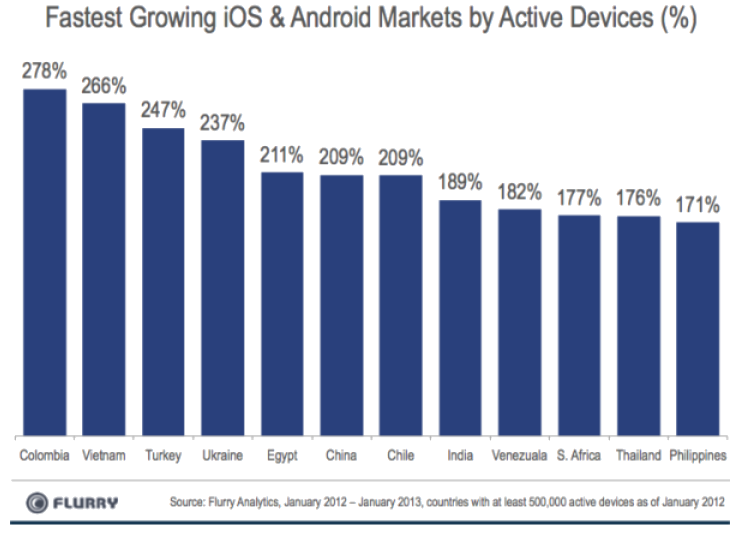
With such impressive figures, of course, the behaviors of Vietnamese smartphone users are interesting to have a quick look at:
 Additionally, the most important user behavior from my perspective that should be taken into consideration by any mobile developer who wants to go into Vietnam market is that Vietnamese users have the tendency to hack/ jailbreak their phones. Free is the very important criterion since the country is still poor with a GDP per capita just slightly above $1,500.
So how does this potential in growth apply to a mobile developers business?
From my own personal experience of running “Vietapps Free”, a free app that provides Vietnamese users every day a free app in English and in Vietnamese, I have some pieces of advice that I would like to share with devs who want to go into the market:
Business model: As mentioned previously, paid-apps might work in the Vietnam market, but free-app would be better as almost everyone hacks their phones. So, the business model is the very first thing that developers should think over. An example for this kind of business model is We Chat, the Chinese communication app, which was (!!!) very popular in Vietnam. The app was launched “free” and advertising was the preferred model. The very first step of this app was to build a massive user base, than it could apply ads as it had done in China. However, since there are some recent conflicts between China and Vietnam, Vietnamese have changed from using this app in place of others.
In the case of Vietapps Free, the business model and the idea behind it is the model of “app recommends other apps” like “Free app a day”. To make it more attractive to Vietnamese users, the app recommends both selective, high-quality apps in two languages: Vietnamese and English every day.
Localization: It is needless to say that localization plays a huge role in the success rate of an app. The market of Vietnam is booming faster and faster and is hungry for high-quality apps. However, the local developers still do not seem to be able to build very high-quality apps because of lacking initial investment as well as experience. So, many “global apps” could gain a great deal of users in Vietnam by localizing their apps, even with just translation their apps description into Vietnamese. In Google Play publisher console, developers can do this by “adding translations” in their descriptions and localize other meta data i.e. screenshots and videos. It would make the app more user-friendly, and cover more keywords in the local market.

With the app Vietapps Free, our team tried to localize the app as much as possible, thus make the app meaningful and more friendly for Vietnamese users. The main colors of the apps are yellow and red with a big yellow star in the icon because of the national flag colors, which make Vietnamese users think that this app is Vietnamese app at the very beginning. Additionally, the number of the app recommended in “Vietapps Free” are limited by number 9 as this number is considered the largest, meaning “lucky” in Vietnamese culture.
Distribution: Google Play and Apple Store are, of course, the primary app stores in VN, but there are others too which have a local audience and reach. Two famous app stores in Vietnam are download.com.vn and appstore.vn. The former is the store for all kind of software and mobile apps and links back to Google Play or the Apple App Store. The latter is the biggest local store for hacked phones. Users can download many paid-apps to their tablets and smartphones for free. However, this app store distributes only Android and iOS apps.
Another thing that developers should consider, is to distribute via alternative app stores. In addition to the local stores, it will help an app to reach Vietnamese users outside Vietnam. However, to publish an app to many app stores simultaneously is not an easy thing. Each store has different requirements and standards regarding the account setup, the meta data required and the reportings provided. In case of “Vietapps Free”, our team looked for both local app stores as well as international ones. Thanks to CondeNgo, a very friendly and easy service to manage uploading apps to 20+ app stores all over the world. With more than 4 million Vietnamese living abroad, who integrate more and more with the local culture and economy, alternative app stores will be distribution channels to approach this community.
Anh Hoang Duc works for Stefan Bielau Consulting: “I hope that my own experiences help you somehow to have an overview of some ideas to consider to come into the Vietnam market. If you have any question or comment, feel free to share them with me: hoangducanh89@gmail.com.”

The “ber” months are here, and this is a sure sign that Christmas is just around the corner. As early as now, you’re probably planning when you’re going to do a general home cleaning. This project can be quite challenging, especially if you’re going to do the job on your own. But nowadays, even if you don’t have anyone else to help you out, you can somewhat rely on certain phone apps to assist you as you plan your cleaning project. By using these applications, you can better organize the work that needs to be done.

1. Useful Cleaning Tips ($0.99)
This app offers how-tos and general cleaning tips that you can use if you encounter common problems, like a blocked drain or stained tiles. There are comprehensive details about how to clean and organize kitchens, bathrooms, clothes, and even leather items. Recommending or sharing the provided tips is made easy because you can do this through Facebook or Twitter, or share helpful info with your contacts too. This is compatible with iPhone, iPad, and iPod Touch.
2. Clean Freak Cleaning Schedule ($0.99)
Again, this is compatible with Apple devices, and it’s a great help for busy moms who certainly have a lot on their minds. The application helps you in itemizing and scheduling your chores so that you won’t feel overwhelmed by everything that you have to do. The Clean Freak has a rotating checklist that shows you when a certain task was last done. This way, you’ll know when you need to clean, say, the bathroom, kitchen or bedroom again. The app also makes it easy for you to add and delete tasks or move them or change their rotation.
3. Good Housekeeping @Home (Free)
Good Housekeeping is one of the most well-known and trusted names in home management, and with their app, valuable tips from this reliable brand become readily available to you whenever you need them. Using your iPhones or iPads, just flick your fingers for helpful info about common stain or cleaning problems. Also, feel inspired by the home decoration ideas that the app offers.
4. Green Shine ($2.99)
Green Shine offers great eco-friendly tips to those who want to keep their homes sparkling clean without using harsh chemicals. For instance, instead of using artificial compounds to clean your leather couch, the app will suggest that you use linseed oil and white vinegar. There are easy-to-do recipes and comprehensive instructions for cleaning. You’ll also find info about how to get rid of stains and how to deal with other more challenging clean up issues. Because you’ll be using natural substances to clean, the app is really helpful if you have kids at home or if you’re pregnant. This app, which you can get through iTunes, can aid in keeping you and your family safe from common yet dangerous cleaning chemicals.
5. Rumgr (Free)
Available on iTunes, this is a great app for anyone who needs to get rid of clutter. Using this application, you can readily put used items that you no longer need on sale. So, instead of staging a garage sale, you do the selling online, which is a more convenient and time-saving approach. Take pictures of items that you want to put on sale and price them. Use Rumgr to promote these through social networking sites, like Twitter and Facebook, or you can create a preferred list of friends to whom you want to sell your things to.
License: Creative Commons image sourceClaire Flint is a full-time freelancer and a stay-at-home mom who has an avid interest in home management. She blogs about her experiences and discusses issues about storage, CleanSweep Services, Inc. services, and interior decoration as well.
From Samsung
| Join “Trusted Seller Program”, NOW!!! | ||||||||||||||||
| Most of developers agree that the best way to get fast testing result is through self testing before submitting application to store. We got that! And that’s why we just started “Trusted Seller Program”. | ||||||||||||||||
|
||||||||||||||||

Ever since the $1.9 billion purchase of 91.com in July by Baidu, many people who hadn’t paid much attention to app stores outside of iTunes and Google Play have all of a sudden taken notice. Since the health of the alternate app store ecosystem is an area near and dear to us, we felt it to be a good time to speak to and where we see things heading in the future. Why are these stores important to developers? What role do they play? How should publishers position themselves for the future with alternate stores?
First, many people ask why these alternate stores even exist. We often hear “why would anyone use anything other than iTunes or Google Play?” Depending on who you ask iTunes and Google Play account for 70-85% of the non-Chinese app download market. Furthermore, with no Google Play store in China, the largest consumer market in the world is dominated by alternate Android app stores. So we believe the right question for a developer to ask is “Do you want access to the other 15-30% of the market that the big 2 don’t own?”
Alternate stores exist for a number of different reasons. Some, like carrier and OEM stores, are legacy stores from the pre-iPhone days. Others like Amazon Appstore are innovating and taking advantage of key competencies that they have over incumbent stores. Yandex and Baidu’s stores are strategically positioned to help their parent companies compete against Google. Still others are social networks where users share and comment on apps. The reasons for being are quite varied but what they all share is a desire for great content to offer their users.
This week Google announced that they would no longer allow 3rd party in-app payment processors in the Play store for the majority of digital goods purchased through apps in the store. We believe that this change, along with new in-app commerce technology enabling multiple payment providers to be included in a single billing SDK like that being offered by Lotaris, have the potential to fundamentally shift the landscape for alternate app stores. The Google Play changes will force payment providers who either depend on mobile or want to get into mobile to find new outlets for their developers’ apps to be distributed and they’re likely to invest heavily for that business. Secondly, if Lotaris is successful or Yandex with their open source in-app billing initiative is successful, then it will open up new revenue streams for many app stores. Most stores make money by selling feature placement. In-app billing is a potentially more profitable revenue stream and would likely lead to new innovations, more customer acquisition efforts and more stores opening up. This is good for stores, good for publishers and will ultimately be good for consumers.
From Samsung:
| Dear Seller Thank you for using Samsung Apps Seller Office; we deeply appreciate your support for our service.The changes detailed below will be introduced as part of our ongoing commitment to service improvement. |
||||||||||||||||||||||||||||||||
|
||||||||||||||||||||||||||||||||
From Google Play
Making Google Play a great community for users is an important part of helping build a successful platform for you as a developer to distribute your apps. From time to time, we update our content policies as part of an ongoing effort to provide a secure and consistent experience for users. We strive to maintain clear guidelines for you as developers, to help us grow this platform and engage with those users.
This email is to notify you that we’ve made some changes to our policies; here are some highlights:
Please review the Google Play Developer Program Policy to see all the changes and make sure your app complies with our updated policies.
Any apps or updates published after this notification are immediately subject to the latest version of the Program Policy. If you find any existing apps in your catalog that don’t comply, we ask you to fix and republish the application within 30 calendar days of receiving this email. After this period, existing applications discovered to be in violation may be subject to warning or removal from Google Play.
We recognize that some developers will need to change their app and advertising practices to comply with the revised policy, but we believe these changes will help ensure all users and developers can maintain confidence in the standard of apps available on Google Play. Our aim is to foster a high standard of app behavior, so you will be able to take advantage of Google Play as a successful platform to distribute your apps and continue to grow your business.
Regards,
Google Play Team
From Samsung:
| Dear Seller, This is the Samsung Apps Seller Office. Thank you for your continued support of the Samsung Apps Seller Office. |
||||||||||
|
||||||||||
From Google Play (we don’t quite know what insert date means in time, but assume ASAP 🙂
Hello,
We’re writing to let you know that we will be introducing Buyer’s Currency in Hungary and Taiwan. All prices for these locales will be in the Hungarian Forint (HUF) and New Taiwan Dollar (TWD) currency, respectively.
Please visit the Google Play Developer Console to set prices for Hungary and Taiwan by August 12, 2013.
IMPORTANT: If you have not manually set pricing for Hungary and Taiwan in the Google Play Android Developer Console by [insert date], 2013, Google Play will automatically assign Buyer’s Currency prices for your products.
Google Play assigns a price based on the price of your app in your home currency, converted to each target currency using the exchange rate on that day. This is a one-time conversion associated with the transition to the new Buyer’s Currency model. If you have already set your per-currency prices manually, Google Play will not override them.
You can continue to set and adjust the prices of your apps at any time, in your home currency and in any Buyer’s Currency available.
For more information about how Buyer’s Currency works, please visit the Google Play Help Center:
http://support.google.com/googleplay/android-developer/bin/answer.py?hl=en&answer=1169947
Thank you for your continued support of Google Play.
Regards,
The Google Play Team

Every year Vision Mobile publishes Developer Economics. We find this report to be one of the most insightful reports on the app economy around, and best of all it’s free. In this article we give you a summary of the highlights, along with our analysis.
Platform choices
The report points to the dominance of Android and iOS, saying the two have created a network effect that nobody can compete against and have created a “Black Ocean” effect in the OS market, which even the biggest of companies can’t compete with: “Even Microsoft with an estimated over 5 billion dollars invested in Windows Phone has managed to secure a tiny 3% smartphones sales share in 2.5 years since the platform launched”. They further point to a relatively low developer mind share for the platform. However this somewhat conflicts with what developers will support going forward, with 40% of developers saying the Windows 8 platform will be an important platform to support, and the leading non iOS/Android platform in terms of mind share. Again, developer support is very closely linked to sales (i.e. addressable market for your apps), which is hardly a surprise. Choice of platform does depend on other things than revenue, which Vision Mobile details in terms of what the developer is interested in:

An interesting observation was made when analyzing Samsung’s bada failure. Vision Mobile goes to say:
“user adoption does not suffice in the new app economy. The positive feedback loop must include developers who benefit from an increased user base. If developers are left out of the loop, the necessary network effects will not kick-in and the platform will fail to grow”.
This is indeed good news for developers going forward, providing this message gets through to all the challengers to the iOS/Android duopoly. There are likely a lot of incentives to be made available over the next few years.
Revenue
Revenue wise, the data shows that iOS leads the pack in terms of average revenue per platform:
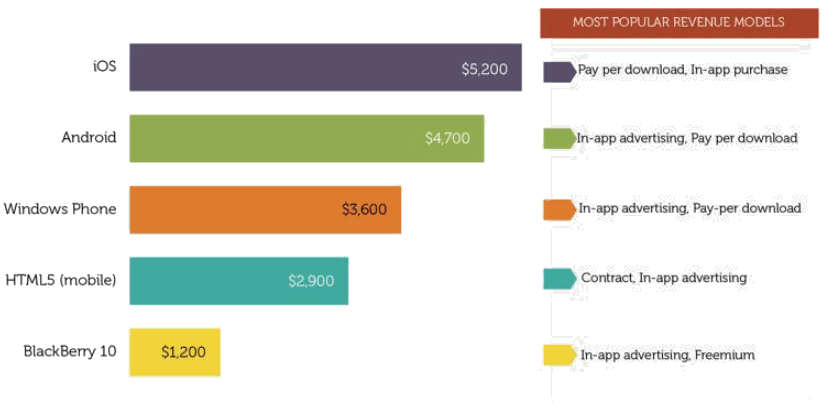
This is somewhat surprising given the number of apps available on the App Store, and is probably due to a bias in the sampling that Vision Mobile has made. In the past, being one of fewer on stores like the BlackBerry store has proven to be quite lucrative for developers.
Tools
Developers increasingly face tough choices in terms of which tools to use, with over 500 companies now providing tools and services. The good news is that tools have proven to be substantially beneficial to developers, highlighted by the fact that the more experienced a developer is, the more likely they are to use tools:

Segmenting the developer
Vision Mobile points out that developers have become a hugely important target for a large number of companies, as “developers are modern-day channels that help them reach new customers, discover new use cases and propel their growth”. Targeting developers is an expensive proposition, and Vision Mobile goes into detail on how to segment developers, not by platforms they work on but by the category they fall under:

They venture on to say that the targeting must be done by these segments, but also points out that developer’s primary incentive is to be creative and get a feeling of achievement when building an app, while building a successful business and having fun is more important than making money. We certainly believe this to be true at CodeNgo as well, which is why our focus is all about taking the pain away from distribution and managing the business, so the focus hopefully can be about enjoying being an app developer.
Where the app economy is going
Forecasts will always have to be taken with a grain of salt, but it is interesting to note that Vision Mobile believes the app economy, which encompasses everything about the building and distribution of apps, will be as much as 50% of the handset market in 2016. This means that the market is likely to be around $143bn in less than 3 years from now, more than doubling the 2013 estimate. Those are numbers we like!
