
Mobile App Growth Strategy in global expansion often leads companies to consider familiar markets such as the United States, Europe, Southeast Asia, and India. However, one of the world’s largest mobile ecosystems is frequently overlooked—not due to a lack of opportunity, but because of its distinct and fragmented distribution landscape.
China is home to hundreds of millions of smartphone users who rely heavily on mobile applications for shopping, banking, entertainment, education, travel, healthcare, and everyday communication. For businesses aiming to reach new audiences, the Chinese app market represents a substantial and largely untapped growth opportunity.
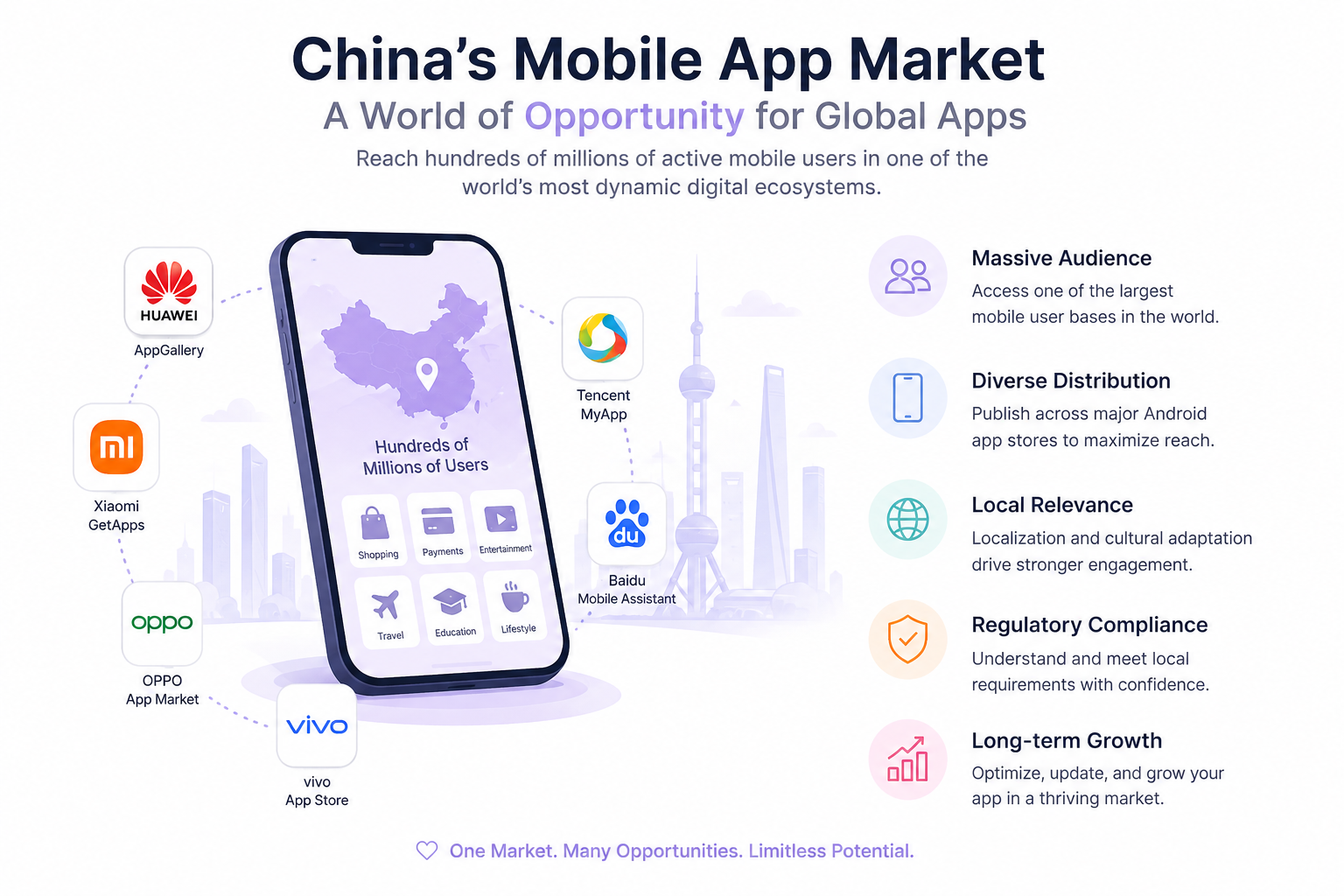
A Different App Distribution Model
One of the biggest misconceptions about launching an Android app in China is assuming that Google Play is the primary distribution channel.
In reality, Google Play is not widely available in mainland China. Instead, Android users download apps through a diverse ecosystem of independent app stores operated by smartphone manufacturers and technology companies.
Some of the largest app stores include:
- Huawei AppGallery
- Xiaomi GetApps
- OPPO App Market
- vivo App Store
- Tencent MyApp
- Baidu Mobile Assistant
Each platform serves millions of active users, making multi-store publishing an important strategy for maximizing visibility.
Rather than relying on a single marketplace, successful app publishers often distribute across multiple stores to reach users throughout the country.
An Enormous Mobile-First Audience
China continues to be one of the world’s most mobile-centric markets.
Consumers use smartphones for nearly every aspect of daily life—from ordering food and booking transportation to online education, digital payments, and entertainment.
For companies in industries such as:
- Education
- E-commerce
- Gaming
- Productivity
- Health & Fitness
- Finance
- Travel
- Lifestyle
the potential audience is substantial.
As smartphone adoption remains high and digital services continue to evolve, businesses that establish an early presence can position themselves for long-term growth.
More Than Translation
Expanding into China involves more than simply translating an app into Chinese.
Localization often includes adapting:
- User interface and language
- Payment methods
- Customer support
- Marketing materials
- Privacy policies
- Cultural expectations
An experience designed specifically for local users generally performs better than a direct copy of an international version.
Understanding local user behavior can significantly improve engagement and retention.
Compliance Matters
China’s app ecosystem has regulatory requirements that differ from many other markets.
Depending on the type of application, publishers may need to consider:
- Business registration requirements
- App filing procedures
- Privacy and data protection regulations
- Content review requirements
- Industry-specific licenses for certain categories
These requirements are intended to ensure compliance with local regulations and may vary depending on the app’s functionality and intended audience.
Preparing for these requirements early can help avoid unnecessary delays during the publishing process.
Beyond Downloads
Publishing an app is only the beginning.
Long-term success depends on continuous optimization, including:
- Monitoring downloads and user engagement
- Updating app listings
- Responding to policy changes
- Releasing new app versions
- Improving app store optimization (ASO)
Because China’s Android ecosystem is distributed across multiple marketplaces, maintaining consistency across stores is an important part of ongoing app management.
A Market Worth Exploring
Entering China’s mobile ecosystem may require additional planning compared to other markets, but it also offers access to one of the largest digital audiences in the world.
As businesses continue expanding globally, including China in an international mobile strategy can open opportunities for increased reach, brand recognition, and long-term growth.
For organizations with products or services that resonate with mobile users, understanding how China’s app ecosystem works is the first step toward participating in one of the world’s most dynamic digital markets.
Share this article on