
Artificial Intelligence is evolving fast—and with it comes a growing list of terms that can feel confusing. Three of the most talked-about concepts today are Generative AI, Agentic AI, and AI Agents.
While they may sound similar, they represent very different levels of capability and autonomy. Understanding these differences can help you decide which approach fits your business, product, or career path.
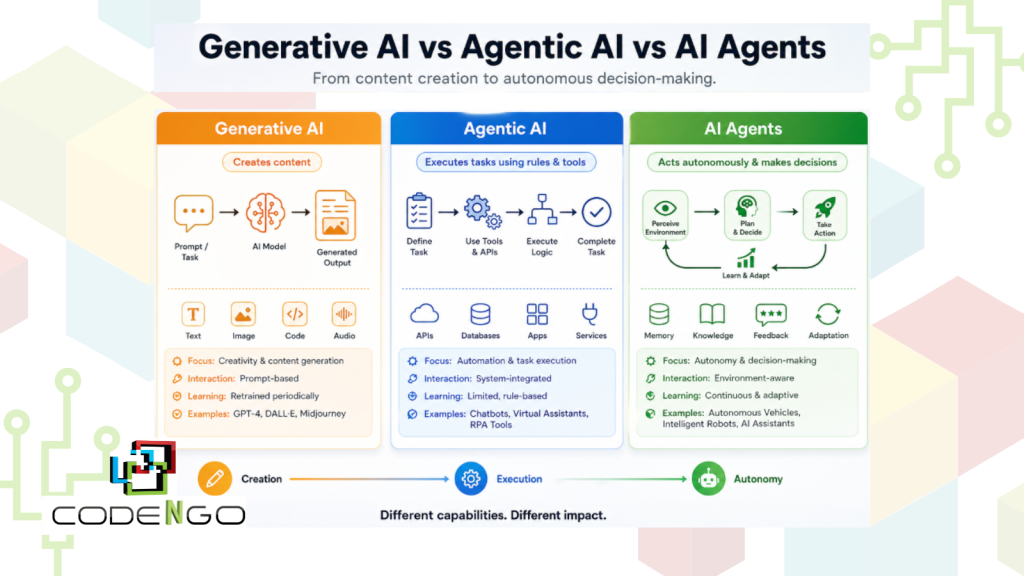
1. Generative AI: The Creator
Generative AI is what most people are familiar with today. It’s designed to create content—whether that’s text, images, code, or audio.
How it works:
- You give it a prompt or task
- It uses trained data to generate a response
- Output is produced instantly, based on patterns it learned during training
Typical workflow:
- Specify a task
- Collect and refine data
- Train a model
- Deploy
- Generate results
- Evaluate outputs
Key characteristics:
- Focused on creativity and content generation
- Not deeply integrated into systems
- Requires human prompts to function
Examples:
- Writing tools (blog posts, emails)
- Image generators
- Code assistants
Limitations:
Generative AI doesn’t “decide” what to do—it simply responds. It lacks autonomy and doesn’t act unless instructed.
2. Agentic AI: The Task Executor
Agentic AI goes a step further. Instead of just generating content, it is designed to complete tasks based on rules, logic, and integrations.
Think of it as AI that can follow instructions more intelligently.
How it works:
- Takes a task
- Selects appropriate models or tools
- Connects to APIs or external systems
- Executes steps based on logic
Typical workflow:
- Define task
- Choose AI model
- Integrate tools/APIs
- Add logic and iteration
- Execute actions
- Improve over time
Key characteristics:
- Can automate workflows
- Works within predefined rules
- Uses tools like APIs to perform actions
Examples:
- Chatbots that can book appointments
- Virtual assistants that pull data from systems
- Workflow automation tools
Limitations:
Agentic AI still relies on structured logic. It doesn’t fully adapt or make complex decisions beyond what it’s programmed to handle.
3. AI Agents: The Decision-Makers
AI Agents represent the most advanced stage. These systems are designed to act autonomously, make decisions, and continuously learn from interactions.
Instead of just executing tasks, they can:
- Plan
- Adapt
- Iterate
- Improve outcomes over time
How it works:
- Receives a goal (not just a task)
- Gathers relevant data
- Designs multi-step processes
- Executes actions
- Learns from results
- Adjusts behavior
Typical workflow:
- Define objective
- Fetch relevant data
- Design multi-step process
- Execute actions
- Evaluate results
- Update memory and improve
Key characteristics:
- Autonomous decision-making
- Continuous interaction with systems
- Learns dynamically from feedback
Examples:
- Autonomous vehicles
- Intelligent robotics
- Advanced business process automation systems
Strength:
AI Agents can operate with minimal human intervention, making them ideal for complex, evolving environments.
Key Differences at a Glance
| Aspect | Generative AI | Agentic AI | AI Agents |
|---|---|---|---|
| Purpose | Create content | Execute tasks | Make decisions |
| Functionality | Creative output | Rule-based automation | Adaptive and autonomous |
| Interaction | Prompt-based | System-integrated | Environment-aware |
| Learning | Retrained periodically | Limited learning | Continuous learning |
| Examples | Text/image generators | Chatbots, assistants | Robots, autonomous systems |
So, Which One Should You Focus On?
It depends on your goals:
- Content creation or marketing? → Start with Generative AI
- Automating workflows or business tasks? → Use Agentic AI
- Building advanced, scalable systems? → Explore AI Agents
Final Thoughts
The shift from Generative AI → Agentic AI → AI Agents represents a move from:
Creation → Execution → Autonomy
We’re entering a phase where AI is no longer just a tool—it’s becoming a collaborator and decision-maker.
If you’re building a business, learning tech skills, or exploring AI opportunities, understanding this progression will give you a major advantage.
Share this article on